all findings
Blog
Insights

"Don't take it easy on me just because I'm a woman"

Text Link
Blog
Insights

"Don't take it easy on me just because I'm a woman"

In celebration of Women's History Month, our Women in Mobile series took over our Apptivate podcast in March 2022. Maria Lannon, Remerge VP of Account Management, talked to app marketers at Bolt, AppsFlyer, Truebill, and Customlytics with a special focus on their challenges and successes in the mobile industry.

Succeeding at app marketing

Not everyone grows up dreaming of a career in mobile app marketing but life has a funny way of showing where your talents will shine brighter. This was the case for Camila Carneiro, Team Lead of Partner Development at Appsflyer, who was one of the four inspirational marketers to join Apptivate's Women in Mobile podcast series in March 2022 for Women's History Month.

Camila is from Brazil and was studying a marketing post-grad abroad in Toronto when she decided to take on a part-time job as a dog sitter. While on the job, she was caring for the dog of a highly accomplished, empowered woman who helped her realize, by example, the type of career she wanted to have.

"It started to open my mind in terms of acknowledging that women belong in big places, and she actually started to help me build my own confidence," said Camila about her mentor by coincidence, "that was a live and clear example of what a woman can achieve and what a woman can be."

Now, Camila strives to be that force of inspiration, mentorship, and comfort for women in the field trying to find their voice and strength in male-dominated environments. "Being the only woman, I found myself sometimes having to listen to men say bad things about women while I was in the room," shares Camila. "I had as much potential as they did, so I should be included in higher-level conversations; I should be involved in meaningful projects. Don't take it easy on me just because I am a woman."

Camila's background paints a perfect picture of how succeeding at app marketing goes beyond doing what's asked for your role. It's also about speaking up and making your voice heard. Camila shares, "if you feel uncomfortable in whatever situation that you might be in because there are only men in the room or because you are feeling judged for being a woman, you need to build the courage to speak up."

Leadership in mobile marketing

Being a leader often comes with a full plate of responsibilities. While being in the right place at the right time goes a long way when it comes to seizing opportunities, it's also a matter of taking matters into your own hands.

Laura Spikermann from Customlytics, talks about her transition into a leadership position and what that experience was like coming from a non-mobile marketing background.

"I visited the office and got talking." Coming from a marketing and HR background, Laura presented her case to join the company, "I started as a consultant so that meant I was responsible for different clients. Even back then we already had bigger clients on board, after training for a while, I was able to take responsibility for those."

« It's a mixture of speaking to colleagues and people from the network to see how they are dealing with situations. »
Laura Spikermann, Client Services Lead at Customlytics

"After time progressed, I was starting my own little team to manage the big clients, and this was after two years of being with the company. Then I gained responsibility for specific team members. And then after another year, as we were restructuring the company, this is how my current position came along."

Laura's experience sheds light on how networking and putting yourself out there get you results. Leadership roles aren't built in a day, but they can certainly waver very easily if there's not a strong foundation to go with it. Laura shares details about the challenges she's faced.

"One of the challenges I faced was that I was pretty close with multiple team members and also friends with them, and when I transitioned into my new position, I had to find a way to set some boundaries and see how we can collaborate together."

"In the beginning, I have to admit I was unsure how it was going to play out. 'Can we still be friends? Can I still be managing someone like that?' but it did work out pretty well. I think it's important to be open about that so I addressed it with them, and went 'Look, I'm going to have to make some decisions that might not always maybe be what you would hope me to do or what you would like me to do, but I would still like to keep your friendship.' So, in the beginning, it was better to set boundaries."

When it came to growing into her leadership role, Laura believes "it's a mixture of speaking to colleagues and people from the network to see how they are dealing with situations. I did reach out to some people I knew from my previous internship or from when I was a working student."

"There's also different ways of learning and training yourself like Skillshare, Masterclass, LinkedIn Learning, and all of those platforms you can use to get some inputs if you wanted to. Also, just noticing how you are dealing with situations and reflecting on it as well, I think that's also important because you can try different methods."

Work-life balance

Particularly for women, there's always added pressure to not only do everything that's expected of them but to go well beyond that. While some of that pressure is self-inflicted, society plays a monumental role in making women believe they always need to be doing more, being more, and dealing with more.

As Fabiana Ayala from Truebill shares, it's okay to hit pause and reshuffle your priorities, ensuring your well-being is front and center, doing what's good for you and your priorities at the time.

"I just put everything in a page and just say, 'Okay, what is going to help me live my best life?'" She also adds, "You can just say 'I won't do it now'" and put something on pause. It's okay to reshuffle your priority list and reflect on what makes you happy. How can you still have plans, ideas, and dreams, but at the same time know what you're capable of doing with that time you have available."

Finding a good work-life balance is easier said than done, with many women juggling different responsibilities and wearing many hats, especially now with entire workforces working remotely. Whether it's family, a side hustle, traveling, or everything in between, it can be taxing to schedule time adequately so it fits the reality of both work and personal calendars. Fabiana is an advocate of having a unified calendar where you schedule both your work and personal events. That way, co-workers can know if you jumped out quickly to grab some groceries, at a doctor's appointment, or in a stakeholder meeting.

"It brings another level of understanding that, especially now when we're working from home, it's just understanding that our schedules can be a bit more flexible and allow for that. I think just putting things on your calendar allows that level of visibility and then you don't need to state every single time that you are going to be offline for half an hour or so."

« I think you have to be true to your word. If you don't want your employees to work overtime, you shouldn't be online during work hours. »
Liia Palipea, Global Head of Food Marketing at Bolt

Mental health and well-being

The past couple of years has made it abundantly clear that mental health conversations need to happen in the workplace. The well-being of employees takes on a higher meaning in these uncertain times as the pandemic has taken a toll on most of us, be it in the form of anxiety, panic attacks, depression, dissociative disorders, insomnia, unhealthy habits, and more.

As Liia Palipea details, "we were given free psychology consultations where you can talk to a psychologist about the pressures that you're having. Mainly, the company gave us this benefit to manage the pandemic but it stayed on and as employees, we can understand the healthy line between the balance of work and life."

Making mental health a priority is pivotal to empowering employees to be their best selves by not just being physically well, but also mentally well. Empathetic leadership helps employees cope with the day-to-day pressures of work, and Liia shares how she encourages her employees to take care of their wellbeing.

"I think you have to be true to your word. If you don't want your employees to work overtime, you shouldn't be online during after-work hours." She also mentions "I generally try not to bother my employees during work hours at holiday time."

Our guests

We cannot emphasize enough how much value our guests poured into the podcast. Hearing different life stories helps give perspective to this crazy world, and gives us the empathy to acknowledge the struggles, challenges, and achievements women get done every single day.

We would like to thank everyone who participated in our Women in Mobile series during Women's History Month:

Fabiana Ayala, Growth Marketing Manager at Truebill

In episode 116, Fabiana shares her experiences speaking up in the workplace with English as a second language. She also discusses her work "must-haves"and why she uses a single calendar to schedule both her personal and professional events, even if it’s just getting groceries.

Camila Carneiro, Team Lead of Partner Development at AppsFlyer

In episode 117 Camila shares her unique experience of what it was like to be the first and only woman in Latin America to work for AppsFlyer. Camila also talks about her passion for speaking up, taking action, and building a community for the inclusion and representation of women in the mobile space.

Liia Palipea, Global Head of Food Marketing at Bolt

Liia brought the app’s new food delivery feature to market in over 20 countries and 70 cities in Europe and Africa during the pandemic. In episode 118 she talks about how this experience taught her how to evaluate what’s important and cope with stress when nothing can be cut from the to-do list.

Laura Spikermann, Client Services Lead at Customlytics

In episode 119 Laura talks about how she began her career in mobile marketing from the ground up at the company. Today, she is responsible for managing the company’s six service departments as the Client Services Lead. Laura shares what she’s learned about stepping into a leadership role—from setting boundaries with friends at work and discovering her leadership style, to restoring her energy through yoga and mental health services.

Event photos
Join our newsletter

Subscribe

* indicates required

By submitting this form, I confirm that I agree to the collection and processing of personal data by Remerge, as further described in the Privacy Policy.

You can unsubscribe at any time by clicking the link in the footer of our emails. For information about our privacy practices, please visit our website.

We use Mailchimp as our marketing platform. By clicking below to subscribe, you acknowledge that your information will be transferred to Mailchimp for processing. Learn more about Mailchimp's privacy practices.

Suggested findings

More thoughts. More stories.

Blog
Insights
How on-demand apps can maximize revenue with in-app retargeting
January 22, 2026
Blog
Insights
How on-demand apps can maximize revenue with in-app retargeting
January 22, 2026
Blog
Insights
AppsFlyer ranks Remerge in top 3 for global gaming on Android
December 3, 2025
Blog
Insights
AppsFlyer ranks Remerge in top 3 for global gaming on Android
December 3, 2025
Blog
Insights
Israel Mobile Summit 2025 - Event highlights
November 17, 2025
Blog
Insights
Israel Mobile Summit 2025 - Event highlights
November 17, 2025
Blog
Insights
App Talk by Remerge in Seoul 2025: Where Trends Meet Tomorrow
November 6, 2025
Blog
Insights
App Talk by Remerge in Seoul 2025: Where Trends Meet Tomorrow
November 6, 2025
Blog
Insights
Flyerside Chats - Remerge discusses retargeting with AppsFlyer
September 26, 2025
Blog
Insights
Flyerside Chats - Remerge discusses retargeting with AppsFlyer
September 26, 2025
Blog
Insights
How Chinese apps are going global with iOS retargeting
July 21, 2025
Blog
Insights
How Chinese apps are going global with iOS retargeting
July 21, 2025
Ep 227: How to find the leaks in your app’s marketing funnel
March 11, 2026
Ep 226: Common LTV mistakes and how to avoid them
February 25, 2026
Ep 225: Dissecting app growth with Louis Tanguay from AGS
February 11, 2026
Company
Product
Case Studies
Guides & Reports
Client Spotlight
Featured
Podcast
Blog
Insights
Retargeting lexicon
Programmatic Advertising

The automated process of buying and selling advertising space through digital platforms.

View-Through Attribution
view-through-attribution

Refer to: Attribution Methodology

Uplift Test
uplift-test

A randomized control trial test conducted by Remerge to measure the incremental impact of one or more campaigns.

See also: Randomized Controlled Trial

Uplift Report
uplift-report

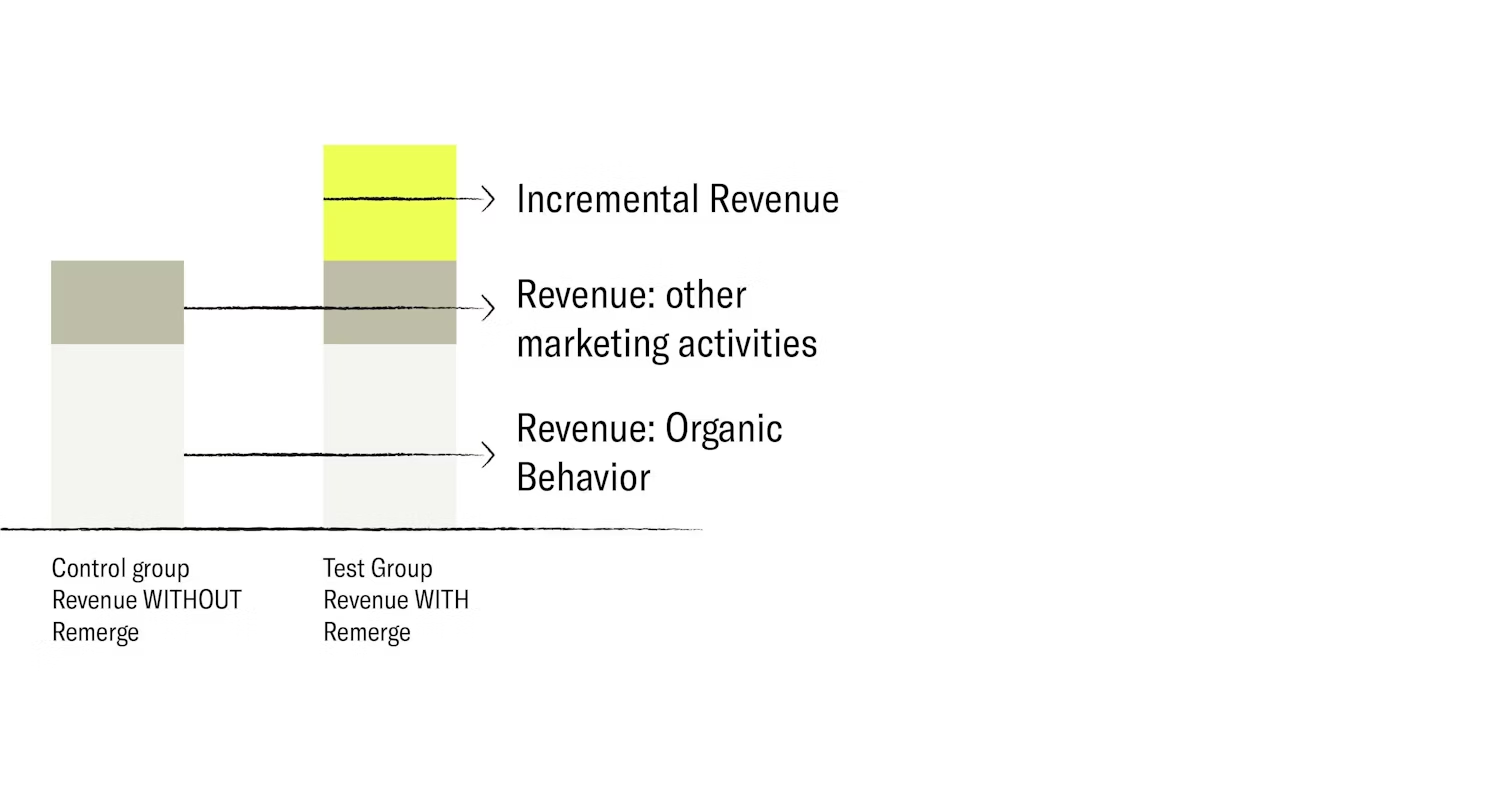
A report by Remerge showing the results of an uplift test. It presents the incremental revenue generated, on top of organic and other marketing-driven conversions. Also contains observed values such as ad spend, group sizes, amount of conversions, converters, and revenues per group, plus other metrics.

SKAdNetwork
skadnetwork

Stands for Store Kit Advertising Network. Apple’s measurement framework for tracking mobile attribution. Introduced in 2018 and widely implemented in 2020 with the iOS 14.5 update.

Segment
segment

A group of users with common attributes such as location, demographics, activity level, value or amount of purchases, and how recently they last opened a specific app.

Retention Rate
retention-rate

The share of users active in the app within certain time frames after install, reengagement, or other events.

Retargeting
retargeting

A type of marketing channel used by an app owner to engage with their existing users through other channels within the same device. Usually, the aim is to encourage users to complete a particular task e.g. completing a purchase, buying in-game currency, placing a first order. The conventional way of retargeting relies on user IDs, such as AAID and IDFA.

Reshuffle
reshuffle

Reshuffle indicates the randomization and marking of users when they were once part of a test or control group.

In incrementality measurement, reshuffling the group assignment for a specific application fights aggregated bias over time where one group doesn't see any ads while the other group is constantly exposed to them.

Reshuffling is relevant in cases where a test has been running for a long time and/or in campaigns the experience more extensive changes to the campaign setups, segmentation, or creative strategy.

Real-Time Bidding (RTB)
real-time-bidding-rtb

The process by which individual ad placements are bought and sold via programmatic auctions that happen instantaneously. With real-time bidding, ad buyers bid on an ad space, which, if the auction is won, instantly displays the buyer's ad. This lets demand-side players such as advertisers or DSPs optimize the purchase of ad placements from multiple sources.

Randomised Controlled Trial (RCT)
randomised-controlled-trial-rct

A method that randomly separates a specific population into two groups that are as similar to each other as possible, namely the test group and control group.

further reading
Queries Per Second (QPS)
queries-per-second-qps

The number of ad placements a DSP is able to process in order to determine on how to bid on them.

Publisher
publisher

Within the sphere of app marketing, a publisher is an App Developer that gets paid for placing ads within their app. For example, an advertiser wants to reach their users via App Y, so they pay App Y to display their ads.

further reading
Public Service Announcement Ad (PSA Ads)
public-service-announcement-ad-psa-ads

An incrementality testing methodology where devices in the control group are shown PSA ads, like donation drives or road safety reminders. By serving real ads, information on the devices within the control group that would have been exposed can be obtained. Unexposed devices are excluded from the measurement to reduce noise.

Probabilistic Attribution
probabilistic-attribution

Refer to: Attribution Methodology

Organic Behavior
organic-behavior

A user’s behavior not directly attributable to specific marketing efforts.

Multi-Touch Attribution
multi-touch-attribution

Refer to: Attribution Methodology

Mobile Measurement Partner (MMP)
mobile-measurement-partner-mmp

Within the sphere of app marketing, MMPs are a service provider that specializes in measuring activities that are happening within and leading to the app. An app publisher may incorporate an MMP into their app to track activity and events e.g. time spent on a certain screen, sources of incoming traffic, app opening frequencies etc.

Lifetime Value (LTV)
lifetime-value-ltv

The amount of revenue generated by the user for the App Developer during the entire duration of the relationship with the user, beginning with the app install.

Last-Click Attribution
last-click-attribution

Refer to: Attribution Methodology

Key Performance Indicator (KPI)
key-performance-indicator-kpi

The key metrics used to assess the effectiveness of an effort in achieving its objective. In programmatic advertising, the common types of performance indicators depend on the goals and nature of each campaign. These can include ROAS, cost per action, and retention rate.

Intent-to-Treat (ITT)
intent-to-treat-itt

An incrementality testing methodology where no ads from the campaign are shown to devices within the control group. Also known as a ‘holdout test’. Cost-free and easy to implement, but with a relatively high level of noise.

This method compares the behavior of all users in both groups. In the test group, this includes both exposed and unexposed users

Incrementality
incrementality

A method of measuring the impact of a specific activity, on top of organic and other activity.

Incremental Revenue (iRevenue)
incremental-revenue-irevenue

The estimated revenue caused directly by the campaign.

Formula:Revenue from test group – revenue from control group = iRevenue

Incremental Return On Ad Spend (iROAS)
incremental-return-on-ad-spend-iroas

A KPI used in calculating how cost-efficient a campaign is. This is used to evaluate the relationship between incremental revenue and the amount of money spent on the campaign. The figure is typically represented in percentage.

Formula:
Percentage: [IRevenue ÷ ad spend] × 100 = IROAS%
Ratio: IRevenue ÷ ad spend = IROAS

Incremental Cost Per Action (iCPA)
incremental-cost-per-action-icpa

A KPI used to evaluate the cost of incremental conversions.

Formula:Ad spend ÷ [test group actions – control group actions] = iCPA

Incremental Conversions
incremental-conversions

The estimated amount of conversions caused directly by the campaign.

Formula:
Test group conversions – control group conversions (scaled) = Incremental conversions

In-app Event
in-app-event

Actions made by a user within the app, such as log-in, registration, completion of onboarding, or purchases. These events can be tracked with the help of an MMP.

Impression
impression

The deployment of the ad to the ad placement. An impression might not necessarily mean that the ad has been viewed.

Identifier for advertisers (IDFA)
identifier-for-advertisers-idfa

A unique random device identifier Apple generates and assigns to every iOS device. Advertisers can use this to track user activity across apps, show them personalized ads, and attribute ad interactions.

Ghost Ads
ghost-ads

A testing methodology that shows devices in the control group an ad ran by another advertiser on the platform, therefore removing any additional cost for clicks and impressions. The control group behavior is then marked with a ‘ghost impression’, which gives the information on which control group users would have been exposed.

further reading
General Data Protection Regulation (GDPR)
general-data-protection-regulation-gdpr

A regulation under the EU (European Union) law on data protection and privacy within the EU and the EEA (European Economic Area), that grants users control over how their data is stored and used by organizations. To comply with GDPR, programmatic sellers must clearly communicate to users how their data will be stored and used. When a user gives consent to an organization to process their data, it enables targeted advertising.

Exposure Rate
exposure-rate

The percentage of devices within a test group that received at least one ad impression, versus the total number of devices within the test group targeted within a campaign during an uplift test. For example, if 900 out of 1,000 users are shown an ad, the exposure rate is 90%.

See also: Uplift Test

Deterministic Attribution
deterministic-attribution

Refer to: Attribution Methodology

Deep link
deep-link

A link that sends users directly to a specific in-app location, instead of the app marketplace. Deep links bypass the steps needed to go through to reach a conversion point, bringing the user directly to where they can perform the intended action e.g. completing a purchase, buying coins, placing an order.

Test Group
test-group

Within the sphere of app marketing, this refers to the group of devices that may be shown ads from a specific campaign in the test. The actions on these devices are then compared to the actions on the devices in the control group.

Compare with: Control Group

further reading
Control Group
control-group

Within the sphere of app marketing, this refers to the group of devices within the target audience that are not shown ads from a specific campaign in the test. The actions on these devices are then compared to the actions on the devices in the test group.

Compare with: Test Group

further reading
Contextual targeting
contextual-targeting

A type of targeting that works with contextual signals only, such as location data (country, city, postal code), language setting, mobile operating system, device model, as well as publisher information.

California Consumer Privacy Act (CCPA)
california-consumer-privacy-act-ccpa

A bill that enhances privacy rights and consumer protection for residents of California, United States. The CCPA took effect on January 1, 2020.

The CCPA provides these rights to consumers:

- Know what personal data is being collected about them.
- Know whether their personal data is sold or disclosed, and to whom.
- Say no to the sale of personal data.
- Access their personal data.
- Request a business to delete any personal information that was collected from that consumer.
- Equal service and price, even if they exercise their privacy rights.

Attribution Window
attribution-window

A specific time frame that is taken into consideration when determining the source of a user’s action.

Attribution Provider (AP)
attribution-provider-ap

A role played by an MMP to credit the in-app activity of users to the correct media sources.

Attribution Methodology
attribution-methodology

Refers to the process of identifying which conversions belong to which preceding click or impression. Common attribution methodologies include:

  • Click-Through Attribution - Determines the source of a conversion based on the user’s click activity.

  • View-Through Attribution - Determines the source of a conversion based on the ad impression delivered to the user.

  • Deterministic Attribution - A model that establishes the origin of a user’s conversion from a specific click or impression, based on unique device IDs.

  • Probabilistic Attribution - A model that establishes the likelihood of a user’s conversion originating from a specific click or impression, based on the data logged on both occasions, such as device language, timezone, IP address, and OS version.

  • Last-Touch Attribution - A model that establishes a match between the action taken by a user (e.g. app open, purchase) and its corresponding ad click or impression. When a user converts from an ad, the DSP that delivered the respective ad is given full credit for that conversion event.

  • Multi-Touch Attribution - Also known as multi-channel attribution. A model determines the value of every touchpoint on the way to a conversion. Rather than giving full credit to one ad, multi-touch attribution divides the credit among all advertising channels that the user has interacted with, leading to the conversion.
Attribution
attribution

A method of identifying the touchpoints a user has encountered within a specified period before making a conversion.

App Tracking Transparency (ATT)
app-tracking-transparency-att

The privacy framework from Apple that, among other things, manages the process of obtaining user consent before accessing their Identifier for Advertiser (IDFA).

App Monetization
app-monetization

The strategy a publisher employs to earn money from their app. This can be done through in-app advertisements, paid membership, and charging for premium features or an ad-free experience, among others. For example, some gaming apps are free to download and play, but users may need to pay in order to progress to the next level quickly.

Android Advertising identifier (AAID)
android-advertising-identifier-aaid

Also known as Google Advertising Identifier. A unique device identifier that Android generates and assigns to every device. Advertisers can use this to track user activity across apps, show them personalized ads, and attribute ad interactions.

Advertisers
advertisers

The advertiser is a person or legal entity focusing on generating sales and leads through serving ads that convey the right message to the right audience at the right time.

In mobile advertising, the advertiser is on the client-side and is the one interested in promoting an app.

Causal Impact Analysis
causal-impact-analysis

A measurement framework developed by Google that works without device IDs. It measures the incremental uplift of one or more conversion events, removing the influence of other campaigns and organic conversions. Used to assess the effect of ID-less campaigns.

Similar to measuring the effect TV ads have, the principle is based on running campaigns on identifiable sub-markets (test group), while leaving other sub-markets unexposed (control group).

Ghost Bids
ghost-bids

An incrementality testing methodology based on Ghost Ads, adapted for retargeting campaigns. The difference is that it removes all devices that are not seen on ad exchanges, or that would not be bid on, from both test and control groups, to reduce noise. A bid is placed as usual for the test group, while the control group is tracked with ‘ghost bids’ (bids that could have been placed, but weren’t in the end).

Return on Advertising Spend (ROAS)
return-on-advertising-spend-roas

A KPI that measures the relationship between the revenue generated by specific advertising efforts and the money spent on them.

Formula

Percentage: [Revenue ÷ ad spend] × 100 = ROAS%

Ratio: Revenue ÷ ad spend = ROAS

See also: Incremental Return On Ad Spend

Supply-Side Platform (SSP)
supply-side-platform-ssp

A company that works with publishers to sell ad inventory across ad networks.

Demand-Side Platform (DSP)
demand-side-platform-dsp

A company that works with advertisers to purchase ad inventory across ad networks. Their platforms are built to identify a desired ad space and place bids on it.

Compare with: Supply-Side Platform

Open RTB
open-rtb

A digital marketplace where ad inventory from multiple publishers are available for advertisers to bid on in real time.

See also: Real-Time Bidding

Self-Attributing Network
self-attributing-network

An ad network like Meta, Snap, and Twitter, that attributes its traffic internally, without the involvement of third-party MMPs.

Variable Bidding
variable-bidding

The dynamic adjustment of bid prices based on a user's in-app behavioral patterns, contextual information, time of day, and ad placement performance.

Dynamic Product Ad (DPA)
dynamic-product-ad-dpa

Also known as a dynamic ad. It is dynamically assembled based on the user’s behavior and information sourced from a feed. This type of ad delivers a tailored experience for individual users.

Real-Time Audience Segmentation
real-time-audience-segmentation

The division of an audience into distinct segments based on real-time events, thus enabling targeted advertising and alignment with a user's behavioral patterns and preferences.

User Acquisition (UA)
user-acquisition-ua

A mobile marketing effort used to attract new users to an app. Paid UA may refer to ads shown in mobile ad networks or social media channels, while non-paid UA involves app store optimization and promotion on the advertiser’s own channels.

Programmatic Advertising
programmatic-advertising

The automated process of buying and selling advertising space through digital platforms.

Blog
Insights