all findings
Blog
Insights

UA after iOS14.5: Is your partner controlling your data?

Text Link
Blog
Insights

UA after iOS14.5: Is your partner controlling your data?

The rollout of Apple's latest software update, iOS 14.5, has introduced a new privacy-centric feature for advertising in which users must now provide consent to in-app tracking. This has become a pivotal moment in the mobile advertising industry, affecting user acquisition and retention tactics along with attribution and the measurement of ROI. Targeting will eventually become less invasive by default.

Apple's change also ties in with legislations such as the General Data Protection Regulation (GDPR) in the EU which came into force in May 2018. The GDPR strictly discusses the handling of user data through definitions such as "data controller" or "data processor". In the context of Demand Side Platform (DSP) partners, the former title could be problematic in the sense that a data controller holds the power to determine the use of the end-user's data.

In this post, learn what a "data controller" is, how to watch out for data-controlling practices, why it's safer to work with a DSP that only processes your app's data, and how this all ties into the new post-IDFA reality.

What's changed in mobile advertising since iOS 14.5?

The main change with iOS 14.5 lies in asking users for their consent to app tracking within each app itself. Previously, users had the option to opt-out and limit ad tracking through their device settings. The shift from passive to active consent means that the Identifier for Advertisers (IDFA) is no longer readily available for marketers. Without the IDFA, traditional attribution and targeting models that track granular behaviors such as app installs, app opens, and in-app user behavior are no longer possible.

The adoption of iOS 14.5 currently lies at 13% worldwide and early data from AppsFlyer shows us that the majority of iOS mobile users will likely not opt in to app tracking, therefore creating a large group of untrackable users in terms of user behavior (i.e. whether they've installed an app or where they may have dropped off). Although a portion of users will still allow app tracking, maintaining ad performance with the ID is only possible if the same users allow app tracking across all apps - both from the publisher and advertiser side.

The opt-in to IDFA rule has, therefore, created a new segment for marketing on iOS: user acquisition without the ID, alongside the commonly known user acquisition and retargeting of users identified with ID.

What makes a UA partner a data controller?

Data controller vs. data processor

Here's a quick recap of the definitions: according to Art. 4 (7). GDPR, a data controller "means the natural or legal person, public authority, agency or other body which, alone or jointly with others, determines the purposes and means of the processing of personal data".

Art. 4 (8). GDPR then states that a data processor "means a natural or legal person, public authority, agency or other body which processes personal data on behalf of the controller".

Why this matters to mobile marketers

In mobile marketing, the control of data resides with the first touch point along with who determines how the collected information will be used. This means that when an ad successfully converts a user for the first time (i.e. through an install), the party that ran the ad creates the first touch point with the customer. IP address, click ID, and specific URL are some of the information acquired through the ad. While user acquisition without the ID is not much of a privacy-topic, understanding the nuances that make a mobile marketing platform either a "data controller" or "data processor" is still advisable.

While the DSP taking the role of a data controller does not breach the GDPR, being a controller comes with a host of further obligations. In particular, one needs consent to process data for its own purposes (the very nature of being a controller as opposed to processors, who work for someone else). When a UA partner acquires a user through an ad, they would need to ask the end-user for consent to create a profile for delivering better ads. However, most advertisements do not provide opt-in banners for remarketing and therefore are in violation of the GDPR.

Another instance is to be a controller without collecting consent. In this scenario, the mobile marketing partner would be a "Joint Controller", according to Art. 26 GDPR. Using the same example, the app would collect consent through their install campaign, and the DSP would use the data for its own purposes, even though they have not collected consent themselves. The various controller obligations would be shared and distributed in a Joint Controller Agreement. The client who is responsible for collecting consent is obliged to inform the user that they are sharing the data with their DSP partner, ask for consent to do so and mention how their partner will be using the data (such as building a profile, covered below). Again, this does not seem possible in UA, as the client cannot collect this consent from the user before their UA partner acquires the user - the partner would have already used the data.

Four things to keep in mind

When a DSP takes on the role of a data processor, the use of data is determined by their client. For a DSP to remain a data processor while offering user acquisition services, the following things must be considered:

1. Storage of information

How the DSP stores advertiser and campaign data determines whether it is controlling or processing data. Storing the data in silos protects the advertiser's data from being used accidentally or intentionally outside of the purposes stated by the advertiser.

2. Audience profiles and lookalikes

A data processor does not build audience profiles nor lookalikes. The accessibility of data based on the point above previously allowed other service providers to profit from the creation of audience profiles. These could be created through the use of IDFAs by tracking all user behavior and then used to create user acquisition strategies. Audience profiles made use of the business secrets of one party to create a successful campaign for a competitor. For example, users could be identified by their purchase history and likelihood to convert. From there, these users would be used for UA campaigns in similar, competing apps. Though this tactic is now rendered useless without the IDFA, we advise mobile marketers to stay vigilant on how their data will and could be used in the future.

A data controller would be allowed to aggregate, sell, transfer, and make use of data for its own or someone else's purpose, whereas a data processor must not.

3. Fingerprinting and Identifier for Vendors (IDFVs)

By aggregating several data sources in connection with an IP address, one could still determine a specific user without the ID. While fingerprinting is forbidden under App Store regulations, pay close attention to other naming conventions. The sharing and selling of data makes a service provider a data controller.

4. Exclusion lists for user acquisition

Using the IDs of already acquired users is considered safe. The data from such lists are shared with the DSP by the advertiser, who is and should be the controller of the data. The use of these IDs for other purposes however, would violate the GDPR if the DSP was only appointed as a data processor; the DSP would, by definition, become a data controller. In this case, processing as a controller would violate the Data Processing Agreement between the client and DSP and would violate GDPR, as there is no longer a "lawful basis" for processing.

How to choose a UA company

While more players enter the user acquisition market, years of industry experience in UA shouldn't be the only deciding factor in selecting a DSP. Without the IDFA, providers must find new ways of driving high-performing campaigns - and the application of privacy-centric practices is not always a guarantee. When choosing a UA partner, go for a holistic approach that takes performance, privacy, transparency, and science into account.

Main takeaway

Even though privacy is now on the radar of the app ecosystem and global legislations are catching up, mobile marketing practices should not necessarily be considered privacy-centric simply with the deprecation of the IDFA.

As the IDFA becomes less available, new practices and services will emerge. The safest way to work with a DSP is to select one that acts as a data processor. This role guarantees the safety and security of the app marketer's data and ensures that it will not be used for other purposes beyond the client's own campaigns.

A note on Remerge

Remerge is the award winning app marketing platform that helps the world's most ambitious apps grow their business, drive revenue, and boost user loyalty. As of May 2021, Remerge has expanded its services beyond app retargeting, and is now also offering user acquisition for ID and NO-ID users. Remerge continues to uphold its standards on privacy by carefully checking each part and process of its business, thereby maintaining the role of the data processor.

Event photos
Join our newsletter

Subscribe

* indicates required

By submitting this form, I confirm that I agree to the collection and processing of personal data by Remerge, as further described in the Privacy Policy.

You can unsubscribe at any time by clicking the link in the footer of our emails. For information about our privacy practices, please visit our website.

We use Mailchimp as our marketing platform. By clicking below to subscribe, you acknowledge that your information will be transferred to Mailchimp for processing. Learn more about Mailchimp's privacy practices.

Suggested findings

More thoughts. More stories.

Blog
Insights
How on-demand apps can maximize revenue with in-app retargeting
January 22, 2026
Blog
Insights
How on-demand apps can maximize revenue with in-app retargeting
January 22, 2026
Blog
Insights
AppsFlyer ranks Remerge in top 3 for global gaming on Android
December 3, 2025
Blog
Insights
AppsFlyer ranks Remerge in top 3 for global gaming on Android
December 3, 2025
Blog
Insights
Israel Mobile Summit 2025 - Event highlights
November 17, 2025
Blog
Insights
Israel Mobile Summit 2025 - Event highlights
November 17, 2025
Blog
Insights
App Talk by Remerge in Seoul 2025: Where Trends Meet Tomorrow
November 6, 2025
Blog
Insights
App Talk by Remerge in Seoul 2025: Where Trends Meet Tomorrow
November 6, 2025
Blog
Insights
Flyerside Chats - Remerge discusses retargeting with AppsFlyer
September 26, 2025
Blog
Insights
Flyerside Chats - Remerge discusses retargeting with AppsFlyer
September 26, 2025
Blog
Insights
How Chinese apps are going global with iOS retargeting
July 21, 2025
Blog
Insights
How Chinese apps are going global with iOS retargeting
July 21, 2025
Ep 227: How to find the leaks in your app’s marketing funnel
March 11, 2026
Ep 226: Common LTV mistakes and how to avoid them
February 25, 2026
Ep 225: Dissecting app growth with Louis Tanguay from AGS
February 11, 2026
Company
Product
Case Studies
Guides & Reports
Client Spotlight
Featured
Podcast
Blog
Insights
Retargeting lexicon
Programmatic Advertising

The automated process of buying and selling advertising space through digital platforms.

View-Through Attribution
view-through-attribution

Refer to: Attribution Methodology

Uplift Test
uplift-test

A randomized control trial test conducted by Remerge to measure the incremental impact of one or more campaigns.

See also: Randomized Controlled Trial

Uplift Report
uplift-report

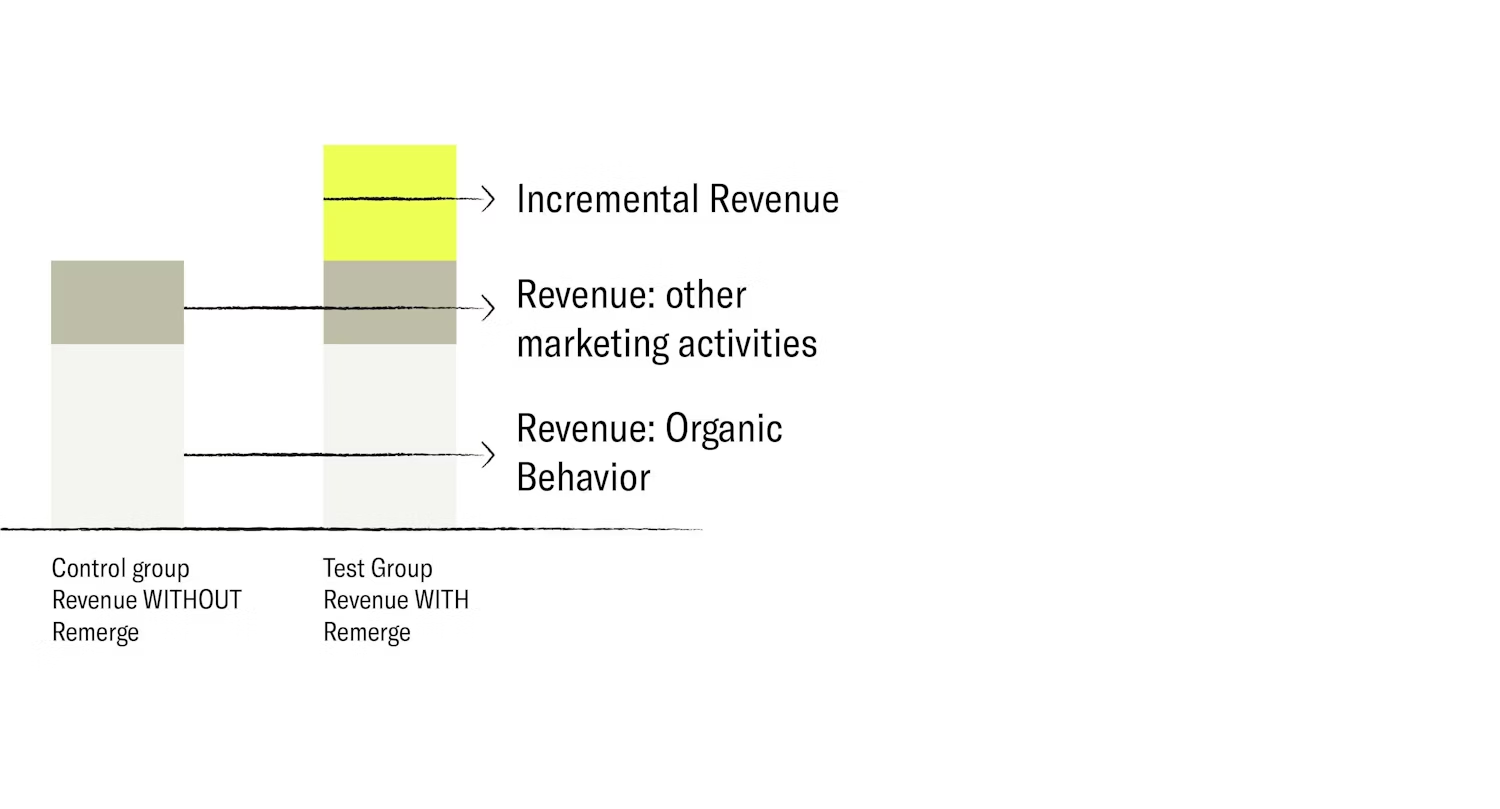
A report by Remerge showing the results of an uplift test. It presents the incremental revenue generated, on top of organic and other marketing-driven conversions. Also contains observed values such as ad spend, group sizes, amount of conversions, converters, and revenues per group, plus other metrics.

SKAdNetwork
skadnetwork

Stands for Store Kit Advertising Network. Apple’s measurement framework for tracking mobile attribution. Introduced in 2018 and widely implemented in 2020 with the iOS 14.5 update.

Segment
segment

A group of users with common attributes such as location, demographics, activity level, value or amount of purchases, and how recently they last opened a specific app.

Retention Rate
retention-rate

The share of users active in the app within certain time frames after install, reengagement, or other events.

Retargeting
retargeting

A type of marketing channel used by an app owner to engage with their existing users through other channels within the same device. Usually, the aim is to encourage users to complete a particular task e.g. completing a purchase, buying in-game currency, placing a first order. The conventional way of retargeting relies on user IDs, such as AAID and IDFA.

Reshuffle
reshuffle

Reshuffle indicates the randomization and marking of users when they were once part of a test or control group.

In incrementality measurement, reshuffling the group assignment for a specific application fights aggregated bias over time where one group doesn't see any ads while the other group is constantly exposed to them.

Reshuffling is relevant in cases where a test has been running for a long time and/or in campaigns the experience more extensive changes to the campaign setups, segmentation, or creative strategy.

Real-Time Bidding (RTB)
real-time-bidding-rtb

The process by which individual ad placements are bought and sold via programmatic auctions that happen instantaneously. With real-time bidding, ad buyers bid on an ad space, which, if the auction is won, instantly displays the buyer's ad. This lets demand-side players such as advertisers or DSPs optimize the purchase of ad placements from multiple sources.

Randomised Controlled Trial (RCT)
randomised-controlled-trial-rct

A method that randomly separates a specific population into two groups that are as similar to each other as possible, namely the test group and control group.

further reading
Queries Per Second (QPS)
queries-per-second-qps

The number of ad placements a DSP is able to process in order to determine on how to bid on them.

Publisher
publisher

Within the sphere of app marketing, a publisher is an App Developer that gets paid for placing ads within their app. For example, an advertiser wants to reach their users via App Y, so they pay App Y to display their ads.

further reading
Public Service Announcement Ad (PSA Ads)
public-service-announcement-ad-psa-ads

An incrementality testing methodology where devices in the control group are shown PSA ads, like donation drives or road safety reminders. By serving real ads, information on the devices within the control group that would have been exposed can be obtained. Unexposed devices are excluded from the measurement to reduce noise.

Probabilistic Attribution
probabilistic-attribution

Refer to: Attribution Methodology

Organic Behavior
organic-behavior

A user’s behavior not directly attributable to specific marketing efforts.

Multi-Touch Attribution
multi-touch-attribution

Refer to: Attribution Methodology

Mobile Measurement Partner (MMP)
mobile-measurement-partner-mmp

Within the sphere of app marketing, MMPs are a service provider that specializes in measuring activities that are happening within and leading to the app. An app publisher may incorporate an MMP into their app to track activity and events e.g. time spent on a certain screen, sources of incoming traffic, app opening frequencies etc.

Lifetime Value (LTV)
lifetime-value-ltv

The amount of revenue generated by the user for the App Developer during the entire duration of the relationship with the user, beginning with the app install.

Last-Click Attribution
last-click-attribution

Refer to: Attribution Methodology

Key Performance Indicator (KPI)
key-performance-indicator-kpi

The key metrics used to assess the effectiveness of an effort in achieving its objective. In programmatic advertising, the common types of performance indicators depend on the goals and nature of each campaign. These can include ROAS, cost per action, and retention rate.

Intent-to-Treat (ITT)
intent-to-treat-itt

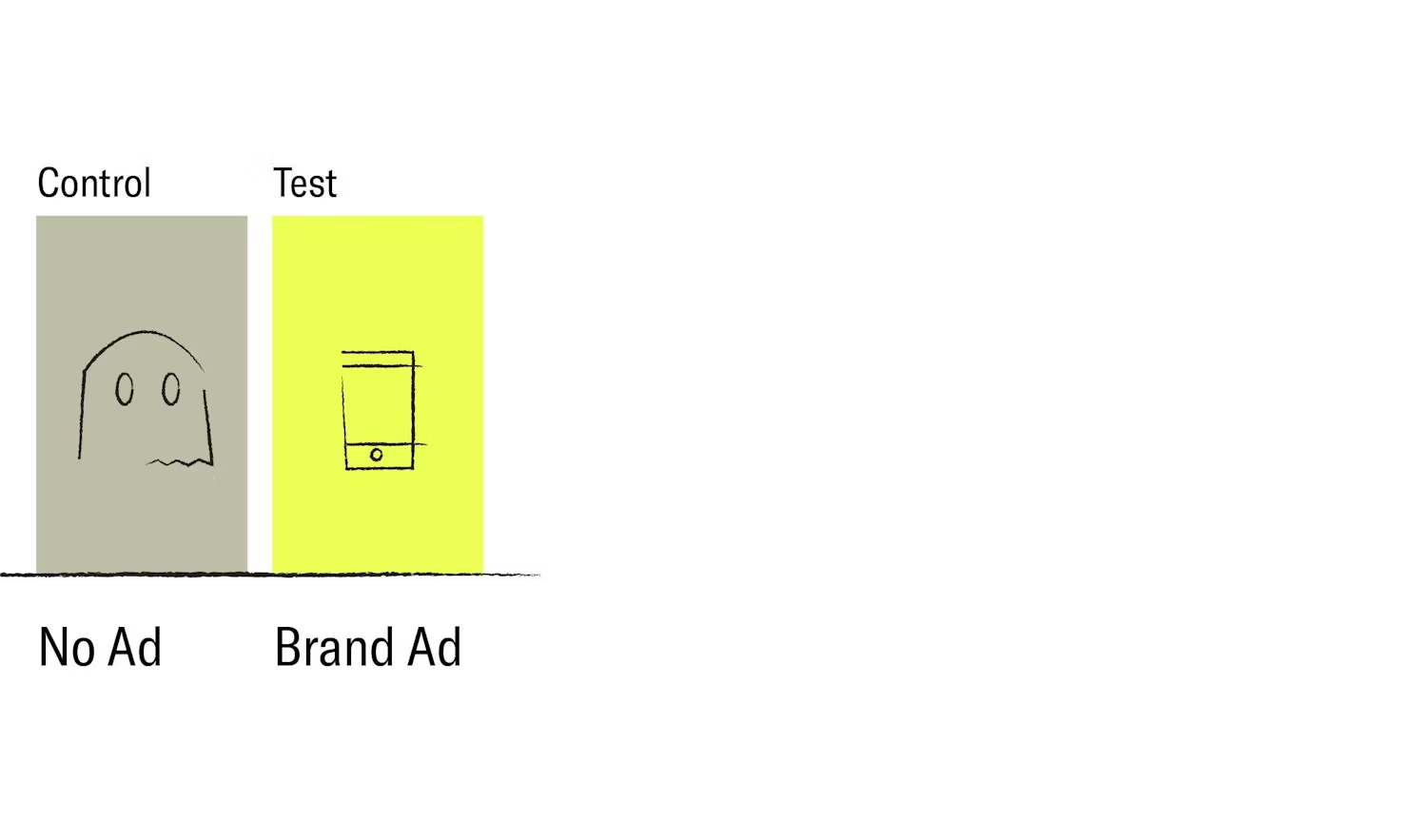
An incrementality testing methodology where no ads from the campaign are shown to devices within the control group. Also known as a ‘holdout test’. Cost-free and easy to implement, but with a relatively high level of noise.

This method compares the behavior of all users in both groups. In the test group, this includes both exposed and unexposed users

Incrementality
incrementality

A method of measuring the impact of a specific activity, on top of organic and other activity.

Incremental Revenue (iRevenue)
incremental-revenue-irevenue

The estimated revenue caused directly by the campaign.

Formula:Revenue from test group – revenue from control group = iRevenue

Incremental Return On Ad Spend (iROAS)
incremental-return-on-ad-spend-iroas

A KPI used in calculating how cost-efficient a campaign is. This is used to evaluate the relationship between incremental revenue and the amount of money spent on the campaign. The figure is typically represented in percentage.

Formula:
Percentage: [IRevenue ÷ ad spend] × 100 = IROAS%
Ratio: IRevenue ÷ ad spend = IROAS

Incremental Cost Per Action (iCPA)
incremental-cost-per-action-icpa

A KPI used to evaluate the cost of incremental conversions.

Formula:Ad spend ÷ [test group actions – control group actions] = iCPA

Incremental Conversions
incremental-conversions

The estimated amount of conversions caused directly by the campaign.

Formula:
Test group conversions – control group conversions (scaled) = Incremental conversions

In-app Event
in-app-event

Actions made by a user within the app, such as log-in, registration, completion of onboarding, or purchases. These events can be tracked with the help of an MMP.

Impression
impression

The deployment of the ad to the ad placement. An impression might not necessarily mean that the ad has been viewed.

Identifier for advertisers (IDFA)
identifier-for-advertisers-idfa

A unique random device identifier Apple generates and assigns to every iOS device. Advertisers can use this to track user activity across apps, show them personalized ads, and attribute ad interactions.

Ghost Ads
ghost-ads

A testing methodology that shows devices in the control group an ad ran by another advertiser on the platform, therefore removing any additional cost for clicks and impressions. The control group behavior is then marked with a ‘ghost impression’, which gives the information on which control group users would have been exposed.

further reading
General Data Protection Regulation (GDPR)
general-data-protection-regulation-gdpr

A regulation under the EU (European Union) law on data protection and privacy within the EU and the EEA (European Economic Area), that grants users control over how their data is stored and used by organizations. To comply with GDPR, programmatic sellers must clearly communicate to users how their data will be stored and used. When a user gives consent to an organization to process their data, it enables targeted advertising.

Exposure Rate
exposure-rate

The percentage of devices within a test group that received at least one ad impression, versus the total number of devices within the test group targeted within a campaign during an uplift test. For example, if 900 out of 1,000 users are shown an ad, the exposure rate is 90%.

See also: Uplift Test

Deterministic Attribution
deterministic-attribution

Refer to: Attribution Methodology

Deep link
deep-link

A link that sends users directly to a specific in-app location, instead of the app marketplace. Deep links bypass the steps needed to go through to reach a conversion point, bringing the user directly to where they can perform the intended action e.g. completing a purchase, buying coins, placing an order.

Test Group
test-group

Within the sphere of app marketing, this refers to the group of devices that may be shown ads from a specific campaign in the test. The actions on these devices are then compared to the actions on the devices in the control group.

Compare with: Control Group

further reading
Control Group
control-group

Within the sphere of app marketing, this refers to the group of devices within the target audience that are not shown ads from a specific campaign in the test. The actions on these devices are then compared to the actions on the devices in the test group.

Compare with: Test Group

further reading
Contextual targeting
contextual-targeting

A type of targeting that works with contextual signals only, such as location data (country, city, postal code), language setting, mobile operating system, device model, as well as publisher information.

California Consumer Privacy Act (CCPA)
california-consumer-privacy-act-ccpa

A bill that enhances privacy rights and consumer protection for residents of California, United States. The CCPA took effect on January 1, 2020.

The CCPA provides these rights to consumers:

- Know what personal data is being collected about them.
- Know whether their personal data is sold or disclosed, and to whom.
- Say no to the sale of personal data.
- Access their personal data.
- Request a business to delete any personal information that was collected from that consumer.
- Equal service and price, even if they exercise their privacy rights.

Attribution Window
attribution-window

A specific time frame that is taken into consideration when determining the source of a user’s action.

Attribution Provider (AP)
attribution-provider-ap

A role played by an MMP to credit the in-app activity of users to the correct media sources.

Attribution Methodology
attribution-methodology

Refers to the process of identifying which conversions belong to which preceding click or impression. Common attribution methodologies include:

  • Click-Through Attribution - Determines the source of a conversion based on the user’s click activity.

  • View-Through Attribution - Determines the source of a conversion based on the ad impression delivered to the user.

  • Deterministic Attribution - A model that establishes the origin of a user’s conversion from a specific click or impression, based on unique device IDs.

  • Probabilistic Attribution - A model that establishes the likelihood of a user’s conversion originating from a specific click or impression, based on the data logged on both occasions, such as device language, timezone, IP address, and OS version.

  • Last-Touch Attribution - A model that establishes a match between the action taken by a user (e.g. app open, purchase) and its corresponding ad click or impression. When a user converts from an ad, the DSP that delivered the respective ad is given full credit for that conversion event.

  • Multi-Touch Attribution - Also known as multi-channel attribution. A model determines the value of every touchpoint on the way to a conversion. Rather than giving full credit to one ad, multi-touch attribution divides the credit among all advertising channels that the user has interacted with, leading to the conversion.
Attribution
attribution

A method of identifying the touchpoints a user has encountered within a specified period before making a conversion.

App Tracking Transparency (ATT)
app-tracking-transparency-att

The privacy framework from Apple that, among other things, manages the process of obtaining user consent before accessing their Identifier for Advertiser (IDFA).

App Monetization
app-monetization

The strategy a publisher employs to earn money from their app. This can be done through in-app advertisements, paid membership, and charging for premium features or an ad-free experience, among others. For example, some gaming apps are free to download and play, but users may need to pay in order to progress to the next level quickly.

Android Advertising identifier (AAID)
android-advertising-identifier-aaid

Also known as Google Advertising Identifier. A unique device identifier that Android generates and assigns to every device. Advertisers can use this to track user activity across apps, show them personalized ads, and attribute ad interactions.

Advertisers
advertisers

The advertiser is a person or legal entity focusing on generating sales and leads through serving ads that convey the right message to the right audience at the right time.

In mobile advertising, the advertiser is on the client-side and is the one interested in promoting an app.

Causal Impact Analysis
causal-impact-analysis

A measurement framework developed by Google that works without device IDs. It measures the incremental uplift of one or more conversion events, removing the influence of other campaigns and organic conversions. Used to assess the effect of ID-less campaigns.

Similar to measuring the effect TV ads have, the principle is based on running campaigns on identifiable sub-markets (test group), while leaving other sub-markets unexposed (control group).

Ghost Bids
ghost-bids

An incrementality testing methodology based on Ghost Ads, adapted for retargeting campaigns. The difference is that it removes all devices that are not seen on ad exchanges, or that would not be bid on, from both test and control groups, to reduce noise. A bid is placed as usual for the test group, while the control group is tracked with ‘ghost bids’ (bids that could have been placed, but weren’t in the end).

Return on Advertising Spend (ROAS)
return-on-advertising-spend-roas

A KPI that measures the relationship between the revenue generated by specific advertising efforts and the money spent on them.

Formula

Percentage: [Revenue ÷ ad spend] × 100 = ROAS%

Ratio: Revenue ÷ ad spend = ROAS

See also: Incremental Return On Ad Spend

Supply-Side Platform (SSP)
supply-side-platform-ssp

A company that works with publishers to sell ad inventory across ad networks.

Demand-Side Platform (DSP)
demand-side-platform-dsp

A company that works with advertisers to purchase ad inventory across ad networks. Their platforms are built to identify a desired ad space and place bids on it.

Compare with: Supply-Side Platform

Open RTB
open-rtb

A digital marketplace where ad inventory from multiple publishers are available for advertisers to bid on in real time.

See also: Real-Time Bidding

Self-Attributing Network
self-attributing-network

An ad network like Meta, Snap, and Twitter, that attributes its traffic internally, without the involvement of third-party MMPs.

Variable Bidding
variable-bidding

The dynamic adjustment of bid prices based on a user's in-app behavioral patterns, contextual information, time of day, and ad placement performance.

Dynamic Product Ad (DPA)
dynamic-product-ad-dpa

Also known as a dynamic ad. It is dynamically assembled based on the user’s behavior and information sourced from a feed. This type of ad delivers a tailored experience for individual users.

Real-Time Audience Segmentation
real-time-audience-segmentation

The division of an audience into distinct segments based on real-time events, thus enabling targeted advertising and alignment with a user's behavioral patterns and preferences.

User Acquisition (UA)
user-acquisition-ua

A mobile marketing effort used to attract new users to an app. Paid UA may refer to ads shown in mobile ad networks or social media channels, while non-paid UA involves app store optimization and promotion on the advertiser’s own channels.

Programmatic Advertising
programmatic-advertising

The automated process of buying and selling advertising space through digital platforms.

Blog
Insights