Incrementality

The scientific way to measure


Incrementality simplifies measurement. Rather than approximating the value of a single click or impression, we pinpoint the exact difference in behavior between a group exposed to your ads and an unexposed group. The result is a clearer answer to the question that matters most: what impact did your advertising actually have?
Diagram showing an experimental group with a pilot measurement followed by a main measurement, and a control group with a pilot measurement followed by a main measurement, leading to a final incrementality calculation.

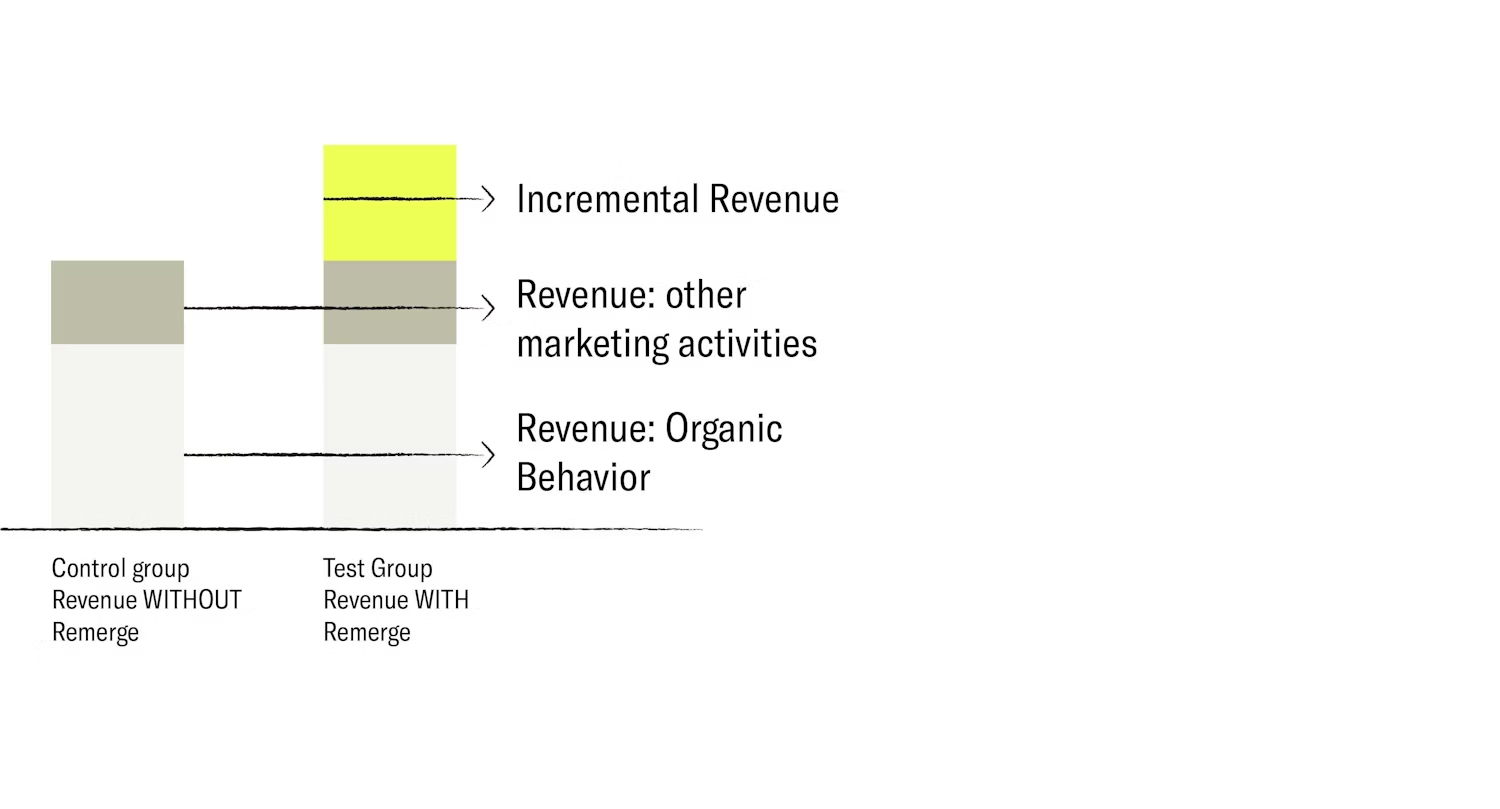
For performance marketers, that means being able to separate genuine campaign uplift from conversions that would have happened anyway. Organic behavior, brand equity, email, push notifications, other paid channels and external factors are already present in the control group. Incrementality measures the additional value created on top of that baseline.

What is incrementality?

Incrementality is a measurement methodology used to determine the causal impact of advertising. Users or markets are divided into comparable treatment and control groups: one group is exposed to a campaign and the other is not. The difference in their outcomes represents the campaign's incremental impact.

The methodology is based on the same principle used in randomized controlled trials. A conversion occurring after exposure to an ad does not necessarily mean the ad caused it. Incrementality is designed to answer that causal question.

Incrementality is how Remerge measures app retargeting campaigns, and the same method applies to user acquisition.

LAST-TOUCH ATTRIBUTION

Ubiquitous, but problematic

The simplicity of last-touch attribution models comes at a price. By incentivizing vendors to push for as many low-cost clicks and views as possible, this model creates an environment prone to fraud in which everybody is fighting to get credit for user behavior, whether they are truly responsible for it or not.

It can't provide you with a clear understanding of the actual value your vendors are contributing because it doesn't account for brand equity, organic behavior, email marketing, push notifications or other external factors. This also makes it difficult to answer a common concern for performance teams: are multiple partners being paid for users who would have converted anyway?

Incrementality provides a way to test this directly. If a conversion would have happened without the campaign, it appears in the control group's baseline. Only the difference between exposed and unexposed groups counts as incremental value.


NON-STOP INNOVATION

Our incrementality solution

Ghost Bids

For the last 5 years, we have been experimenting with three different methodologies: Intent-to-Treat, PSA, and Ghost Bids. Through conducting thousands of tests and developing our own analysis framework, we've created a version of the Ghost Bids methodology that allows for always-on, cost-free, and reliable measurement in re-engagement uplift. Ghost Bids are particularly suited to retargeting because they reduce noise and selection bias. Instead of simply withholding ads from a random control group, the methodology focuses on users who could genuinely have been reached through the campaign. This makes the comparison between exposed and unexposed users more meaningful.

Causal Impact Analysis

Since 2019, we’ve been developing our Causal Impact incrementality measurement framework, a method specifically designed to work independently of user IDs. Rooted in econometrics, it is able to observe both the install and re-engagement uplift of campaigns, thus providing valuable insights on top of SKAdNetwork metrics.

By comparing identifiable treatment and control sub-markets, Causal Impact can isolate the incremental effect of a campaign from broader trends and organic behavior. This makes it particularly valuable for measuring no-ID traffic, where deterministic attribution alone cannot provide the full picture.

For a comparison of the three test designs, read Incrementality Tests 101: Intent-to-Treat, PSA, Ghost Ads and Ghost Bids.

Incrementality in practice

Incrementality is only useful if the methodology stands up to scrutiny. That means transparent test design, balanced groups and results that can be independently validated.

Miniclip verified the methodology

When Miniclip ran an incrementality test with Remerge for its 8 Ball Pool retargeting campaigns, the team went beyond simply accepting the reported results. Miniclip compared Remerge's randomization data with its own internal behavioral data, including activity, matches played, player level, lifetime value and retention.

Using Distribution Matching, Miniclip found that the treatment and control groups were perfectly balanced across the KPIs it examined - an independent validation of the randomization methodology.

“Remerge's transparent approach towards incrementality testing has made it easy to verify their results from our end.”
- Jamie Lee, Digital Marketing Analyst, Miniclip

Read the Miniclip incrementality study

Socialpoint found its lowest-ever incremental acquisition costs

Socialpoint used Remerge's Causal Impact methodology to measure the incremental performance of User Acquisition campaigns for Dragon City. Over an eight-week period, the teams ran 14 tests and experimented with different creative formats.

The results delivered Socialpoint's lowest-ever iCPI and iCPA figures, while also showing that video outperformed static and native formats in both CTR and conversion rate. The tests gave Socialpoint actionable evidence for how to optimize future UA activity rather than relying solely on attributed performance.

“We are doubling down on building tools that will enable our UA teams to measure actions with 100% incrementality in the event that all other types of measurement move away.”
- Alexandre Noirot-Cosson, Head of Marketing for Live Games, Socialpoint

Read the Socialpoint case study

PhotoSì identified when to spend

For seasonal businesses, performance can change dramatically depending on the time of day, day of week and wider calendar. PhotoSì worked with Remerge on a series of incrementality tests over four weeks, testing supply partners, creatives and campaign timing across ID and no-ID traffic.

The findings showed that weekends and evenings were the strongest times to run campaigns, while video and interstitials were the best-performing creative formats. The predictive model also highlighted the importance of seasonality, helping PhotoSì make more informed decisions about where and when to allocate budget.

“Incrementality testing gives you another perspective of your User Acquisition activity, which you don’t have with a deterministic approach.”
- Manuel Mainetti, PhotoSì

Read the PhotoSì case study

Delivery Hero measured value in a no-ID world

Delivery Hero became one of the first advertisers to use Remerge's incrementality solution for User Acquisition on no-ID traffic. Starting with HungerStation in Saudi Arabia, the teams first ran multiple experiments on ID traffic using different creative formats during peak evening hours.

Those learnings were then used to inform tests on no-ID traffic. The project helped achieve competitive CPI performance, identify campaign elements for future optimization and demonstrate the incremental value of the advertising activity.

Read the Delivery Hero case study

How to run an incrementality test

A successful incrementality test starts with a business question, not a methodology. Before launching a campaign, define exactly what you need to prove.

1. Define the conversion event

Decide what outcome the campaign should create. Depending on your business, this could be an install, registration, purchase, order, re-engagement or incremental revenue. The KPI should reflect the business objective rather than simply the easiest event to measure.

2. Create comparable test and control groups

For retargeting, users should be randomly assigned so that they remain in either the treatment or control group. This is essential for avoiding overlap and ensuring that differences in outcomes can be attributed to the advertising exposure.

For no-ID campaigns, comparable treatment and control sub-markets can be used instead, allowing aggregated data and econometric analysis to measure campaign uplift.

3. Run long enough to generate meaningful data

The right test duration and group size depend on audience volume, expected conversion rates and the size of the effect being measured. A test needs enough data to distinguish a genuine signal from normal variation.

4. Compare outcomes, not just attributed conversions

The control group represents the baseline: conversions and revenue generated through organic behavior, other marketing activities and external influences. The treatment group shows what happened with the advertising campaign running.

The difference between those outcomes is the incremental contribution of the campaign.

5. Use the results to optimize decisions

The value of incrementality is not simply proving whether a campaign worked. Results can be used to compare creatives, audiences, supply partners, times of day, geographies and optimization strategies, and then move budget toward activity that creates genuine additional value.

How to read incremental ROAS

Traditional ROAS measures attributed revenue against advertising spend. Incremental ROAS, or iROAS, focuses only on the additional revenue caused by the campaign.

Incremental revenue ÷ ad spend = iROAS

For example, if an exposed group generates more revenue than a comparable control group, the difference is the campaign's incremental revenue. Dividing that additional revenue by spend gives you iROAS.

Worked examples are in our guide to interpreting incremental ROAS.

The same principle applies to other incremental KPIs:

  • iCPI measures the cost of each additional install generated by the campaign.
  • iCPA measures the cost of each additional conversion or action.
  • Incremental uplift measures the difference in conversion or revenue outcomes between treatment and control groups.

What is a good incremental ROAS?

There is no universal benchmark. A good iROAS depends on your margins, customer lifetime value, payback period and the conversion event being optimized.

For example, an e-commerce app may be able to evaluate incremental revenue directly. A food delivery app with relatively fixed profit per order may prefer to set an iCPA target based on the profit generated by each incremental conversion.

The important distinction is between attributed performance and incremental performance. A campaign can report a strong attributed ROAS while contributing little additional revenue if many of those users would have converted anyway. Incremental KPIs provide the evidence needed to make that distinction.

Frequently asked questions about incrementality

What is incrementality in marketing?

Incrementality measures the additional outcome caused by a marketing activity. It compares the behavior of an exposed treatment group with an unexposed control group to determine whether the advertising created genuine uplift.

How is incrementality different from attribution?

Attribution assigns credit for a conversion to one or more marketing touchpoints. Incrementality measures whether a campaign actually caused an additional conversion, action or revenue outcome. The two approaches can work alongside each other: attribution can provide standardized operational reporting, while incrementality can validate whether attributed results reflect genuine value.

We compare the two approaches in more depth in Attribution vs incrementality: pros and cons.

What is incremental ROAS?

Incremental ROAS, or iROAS, is the revenue generated in addition to what would have happened without advertising, divided by ad spend. It is designed to measure the true return created by a campaign rather than all revenue attributed to it.

How does incrementality prevent double-paying for users?

Incrementality does not attempt to decide which partner should receive attribution for an individual conversion. Instead, it measures the total additional effect of a campaign against a control baseline. If users would have converted without a campaign, that behavior is reflected in the control group rather than counted as incremental value.

Can incrementality be measured without device IDs?

Yes. Causal Impact methodologies can use aggregated data and identifiable sub-markets rather than individual user IDs. This makes incrementality particularly useful for measuring the effectiveness of no-ID campaigns.

How do you know an incrementality test is reliable?

Reliable tests require comparable treatment and control groups, sufficient sample size and duration, clear KPI definitions and a methodology that can be independently verified. Transparency is critical: advertisers should be able to understand how groups were created and validate the analysis with their own data where appropriate.

Should incrementality replace traditional attribution?

Not necessarily. Attribution and incrementality answer different questions. Attribution helps marketers report and operate campaigns across channels, while incrementality helps validate whether those campaigns are creating additional business value. Used together, incrementality can provide an important calibration layer for attribution models.

When should I use incrementality testing?

Incrementality is particularly valuable when you need to prove campaign uplift to leadership, evaluate the true value of retargeting, compare partners or channels, optimize budget allocation, measure no-ID traffic or investigate whether attributed conversions are cannibalizing organic behavior.

Measure what your campaigns actually change

Clicks and attributed conversions can tell you what happened after an ad was served. Incrementality helps answer the harder question: what would have happened without it?

That difference is what performance teams can take to leadership when defending spend, evaluating partners and deciding where the next budget should go.

Everything you’d expect from a mobile DSP, but done better.

get in touch
Retargeting lexicon
Programmatic Advertising

The automated process of buying and selling advertising space through digital platforms.

View-Through Attribution
view-through-attribution

Refer to: Attribution Methodology

‍

Uplift Test
uplift-test

A randomized control trial test conducted by Remerge to measure the incremental impact of one or more campaigns.

See also: Randomized Controlled Trial

Uplift Report
uplift-report

A report by Remerge showing the results of an uplift test. It presents the incremental revenue generated, on top of organic and other marketing-driven conversions. Also contains observed values such as ad spend, group sizes, amount of conversions, converters, and revenues per group, plus other metrics.

SKAdNetwork
skadnetwork

Stands for Store Kit Advertising Network. Apple’s measurement framework for tracking mobile attribution. Introduced in 2018 and widely implemented in 2020 with the iOS 14.5 update.

Segment
segment

A group of users with common attributes such as location, demographics, activity level, value or amount of purchases, and how recently they last opened a specific app.

Retention Rate
retention-rate

The share of users active in the app within certain time frames after install, reengagement, or other events.

Retargeting
retargeting

A type of marketing channel used by an app owner to engage with their existing users through other channels within the same device. Usually, the aim is to encourage users to complete a particular task e.g. completing a purchase, buying in-game currency, placing a first order. The conventional way of retargeting relies on user IDs, such as AAID and IDFA.

Reshuffle
reshuffle

Reshuffle indicates the randomization and marking of users when they were once part of a test or control group.

In incrementality measurement, reshuffling the group assignment for a specific application fights aggregated bias over time where one group doesn't see any ads while the other group is constantly exposed to them.

Reshuffling is relevant in cases where a test has been running for a long time and/or in campaigns the experience more extensive changes to the campaign setups, segmentation, or creative strategy.

Real-Time Bidding (RTB)
real-time-bidding-rtb

The process by which individual ad placements are bought and sold via programmatic auctions that happen instantaneously. With real-time bidding, ad buyers bid on an ad space, which, if the auction is won, instantly displays the buyer's ad. This lets demand-side players such as advertisers or DSPs optimize the purchase of ad placements from multiple sources.

Randomised Controlled Trial (RCT)
randomised-controlled-trial-rct

A method that randomly separates a specific population into two groups that are as similar to each other as possible, namely the test group and control group.

__wf_reserved_inherit
further reading
Queries Per Second (QPS)
queries-per-second-qps

The number of ad placements a DSP is able to process in order to determine on how to bid on them.

Publisher
publisher

Within the sphere of app marketing, a publisher is an App Developer that gets paid for placing ads within their app. For example, an advertiser wants to reach their users via App Y, so they pay App Y to display their ads.

further reading
Public Service Announcement Ad (PSA Ads)
public-service-announcement-ad-psa-ads

An incrementality testing methodology where devices in the control group are shown PSA ads, like donation drives or road safety reminders. By serving real ads, information on the devices within the control group that would have been exposed can be obtained. Unexposed devices are excluded from the measurement to reduce noise.

Probabilistic Attribution
probabilistic-attribution

Refer to: Attribution Methodology

Organic Behavior
organic-behavior

A user’s behavior not directly attributable to specific marketing efforts.

Multi-Touch Attribution
multi-touch-attribution

Refer to: Attribution Methodology

Mobile Measurement Partner (MMP)
mobile-measurement-partner-mmp

Within the sphere of app marketing, MMPs are a service provider that specializes in measuring activities that are happening within and leading to the app. An app publisher may incorporate an MMP into their app to track activity and events e.g. time spent on a certain screen, sources of incoming traffic, app opening frequencies etc.

Lifetime Value (LTV)
lifetime-value-ltv

The amount of revenue generated by the user for the App Developer during the entire duration of the relationship with the user, beginning with the app install.

Last-Click Attribution
last-click-attribution

Refer to: Attribution Methodology

Key Performance Indicator (KPI)
key-performance-indicator-kpi

The key metrics used to assess the effectiveness of an effort in achieving its objective. In programmatic advertising, the common types of performance indicators depend on the goals and nature of each campaign. These can include ROAS, cost per action, and retention rate.

Intent-to-Treat (ITT)
intent-to-treat-itt

An incrementality testing methodology where no ads from the campaign are shown to devices within the control group. Also known as a ‘holdout test’. Cost-free and easy to implement, but with a relatively high level of noise.

This method compares the behavior of all users in both groups. In the test group, this includes both exposed and unexposed users

Incrementality
incrementality

A method of measuring the impact of a specific activity, on top of organic and other activity.

__wf_reserved_inherit
Incremental Revenue (iRevenue)
incremental-revenue-irevenue

The estimated revenue caused directly by the campaign.

Formula:Revenue from test group – revenue from control group = iRevenue
__wf_reserved_inherit
Incremental Return On Ad Spend (iROAS)
incremental-return-on-ad-spend-iroas

A KPI used in calculating how cost-efficient a campaign is. This is used to evaluate the relationship between incremental revenue and the amount of money spent on the campaign. The figure is typically represented in percentage.

Formula:
Percentage: [IRevenue ÷ ad spend] × 100 = IROAS%
Ratio: IRevenue ÷ ad spend = IROAS

__wf_reserved_inherit
Incremental Cost Per Action (iCPA)
incremental-cost-per-action-icpa

A KPI used to evaluate the cost of incremental conversions.

Formula:Ad spend ÷ [test group actions – control group actions] = iCPA

Incremental Conversions
incremental-conversions

The estimated amount of conversions caused directly by the campaign.

Formula:
Test group conversions – control group conversions (scaled) = Incremental conversions

In-app Event
in-app-event

Actions made by a user within the app, such as log-in, registration, completion of onboarding, or purchases. These events can be tracked with the help of an MMP.

Impression
impression

The deployment of the ad to the ad placement. An impression might not necessarily mean that the ad has been viewed.

Identifier for advertisers (IDFA)
identifier-for-advertisers-idfa

A unique random device identifier Apple generates and assigns to every iOS device. Advertisers can use this to track user activity across apps, show them personalized ads, and attribute ad interactions.

Ghost Ads
ghost-ads

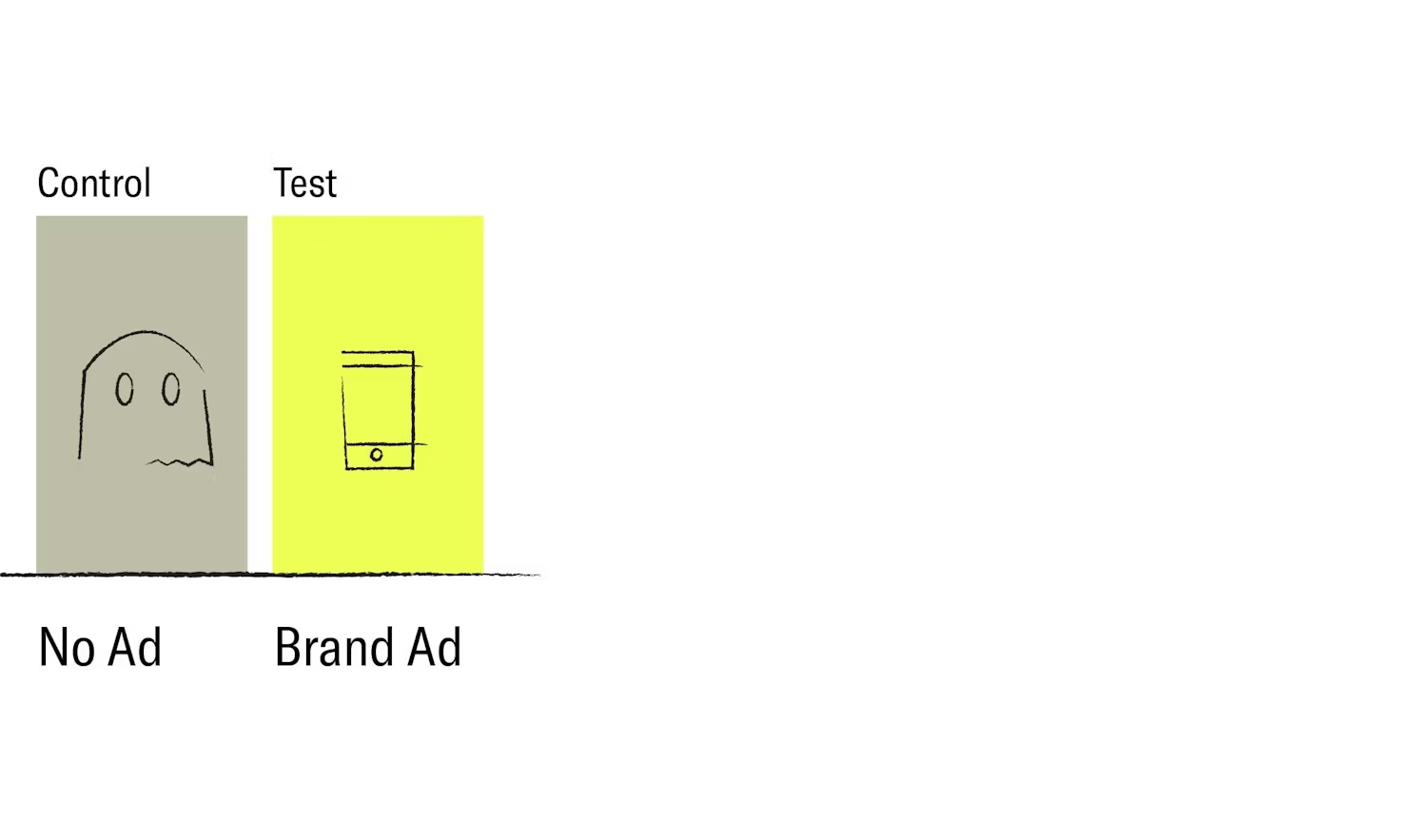
A testing methodology that shows devices in the control group an ad ran by another advertiser on the platform, therefore removing any additional cost for clicks and impressions. The control group behavior is then marked with a ‘ghost impression’, which gives the information on which control group users would have been exposed.
__wf_reserved_inherit
General Data Protection Regulation (GDPR)
general-data-protection-regulation-gdpr

A regulation under the EU (European Union) law on data protection and privacy within the EU and the EEA (European Economic Area), that grants users control over how their data is stored and used by organizations. To comply with GDPR, programmatic sellers must clearly communicate to users how their data will be stored and used. When a user gives consent to an organization to process their data, it enables targeted advertising.

Exposure Rate
exposure-rate

The percentage of devices within a test group that received at least one ad impression, versus the total number of devices within the test group targeted within a campaign during an uplift test. For example, if 900 out of 1,000 users are shown an ad, the exposure rate is 90%.

See also: Uplift Test
Deterministic Attribution
deterministic-attribution

Refer to: Attribution Methodology

Deep link
deep-link

A link that sends users directly to a specific in-app location, instead of the app marketplace. Deep links bypass the steps needed to go through to reach a conversion point, bringing the user directly to where they can perform the intended action e.g. completing a purchase, buying coins, placing an order.

Test Group
test-group

Within the sphere of app marketing, this refers to the group of devices that may be shown ads from a specific campaign in the test. The actions on these devices are then compared to the actions on the devices in the control group.

Compare with: Control Group

__wf_reserved_inherit
further reading
Control Group
control-group

Within the sphere of app marketing, this refers to the group of devices within the target audience that are not shown ads from a specific campaign in the test. The actions on these devices are then compared to the actions on the devices in the test group.

Compare with: Test Group

__wf_reserved_inherit
further reading
Contextual targeting
contextual-targeting

A type of targeting that works with contextual signals only, such as location data (country, city, postal code), language setting, mobile operating system, device model, as well as publisher information.

California Consumer Privacy Act (CCPA)
california-consumer-privacy-act-ccpa

A bill that enhances privacy rights and consumer protection for residents of California, United States. The CCPA took effect on January 1, 2020.

The CCPA provides these rights to consumers:

- Know what personal data is being collected about them.
- Know whether their personal data is sold or disclosed, and to whom.
- Say no to the sale of personal data.
- Access their personal data.
- Request a business to delete any personal information that was collected from that consumer.
- Equal service and price, even if they exercise their privacy rights.

Attribution Window
attribution-window

A specific time frame that is taken into consideration when determining the source of a user’s action.

Attribution Provider (AP)
attribution-provider-ap

A role played by an MMP to credit the in-app activity of users to the correct media sources.

Attribution Methodology
attribution-methodology

Refers to the process of identifying which conversions belong to which preceding click or impression. Common attribution methodologies include:

  • Click-Through Attribution - Determines the source of a conversion based on the user’s click activity.

  • View-Through Attribution - Determines the source of a conversion based on the ad impression delivered to the user.

  • Deterministic Attribution - A model that establishes the origin of a user’s conversion from a specific click or impression, based on unique device IDs.

  • Probabilistic Attribution - A model that establishes the likelihood of a user’s conversion originating from a specific click or impression, based on the data logged on both occasions, such as device language, timezone, IP address, and OS version.

  • Last-Touch Attribution - A model that establishes a match between the action taken by a user (e.g. app open, purchase) and its corresponding ad click or impression. When a user converts from an ad, the DSP that delivered the respective ad is given full credit for that conversion event.

  • Multi-Touch Attribution - Also known as multi-channel attribution. A model determines the value of every touchpoint on the way to a conversion. Rather than giving full credit to one ad, multi-touch attribution divides the credit among all advertising channels that the user has interacted with, leading to the conversion.
Attribution
attribution

A method of identifying the touchpoints a user has encountered within a specified period before making a conversion.

App Tracking Transparency (ATT)
app-tracking-transparency-att

The privacy framework from Apple that, among other things, manages the process of obtaining user consent before accessing their Identifier for Advertiser (IDFA).

App Monetization
app-monetization

The strategy a publisher employs to earn money from their app. This can be done through in-app advertisements, paid membership, and charging for premium features or an ad-free experience, among others. For example, some gaming apps are free to download and play, but users may need to pay in order to progress to the next level quickly.

Android Advertising identifier (AAID)
android-advertising-identifier-aaid

Also known as Google Advertising Identifier. A unique device identifier that Android generates and assigns to every device. Advertisers can use this to track user activity across apps, show them personalized ads, and attribute ad interactions.

Advertisers
advertisers

The advertiser is a person or legal entity focusing on generating sales and leads through serving ads that convey the right message to the right audience at the right time.

In mobile advertising, the advertiser is on the client-side and is the one interested in promoting an app.

Causal Impact Analysis
causal-impact-analysis

A measurement framework developed by Google that works without device IDs. It measures the incremental uplift of one or more conversion events, removing the influence of other campaigns and organic conversions. Used to assess the effect of ID-less campaigns.

Similar to measuring the effect TV ads have, the principle is based on running campaigns on identifiable sub-markets (test group), while leaving other sub-markets unexposed (control group).

Ghost Bids
ghost-bids

An incrementality testing methodology based on Ghost Ads, adapted for retargeting campaigns. The difference is that it removes all devices that are not seen on ad exchanges, or that would not be bid on, from both test and control groups, to reduce noise. A bid is placed as usual for the test group, while the control group is tracked with ‘ghost bids’ (bids that could have been placed, but weren’t in the end).

Return on Advertising Spend (ROAS)
return-on-advertising-spend-roas

A KPI that measures the relationship between the revenue generated by specific advertising efforts and the money spent on them.

Formula

Percentage: [Revenue ÷ ad spend] × 100 = ROAS%

Ratio: Revenue ÷ ad spend = ROAS

See also: Incremental Return On Ad Spend

Supply-Side Platform (SSP)
supply-side-platform-ssp

A company that works with publishers to sell ad inventory across ad networks.

Demand-Side Platform (DSP)
demand-side-platform-dsp

A company that works with advertisers to purchase ad inventory across ad networks. Their platforms are built to identify a desired ad space and place bids on it.

Compare with: Supply-Side Platform

Open RTB
open-rtb

A digital marketplace where ad inventory from multiple publishers are available for advertisers to bid on in real time.

See also: Real-Time Bidding

Self-Attributing Network
self-attributing-network

An ad network like Meta, Snap, and Twitter, that attributes its traffic internally, without the involvement of third-party MMPs.

Variable Bidding
variable-bidding

The dynamic adjustment of bid prices based on a user's in-app behavioral patterns, contextual information, time of day, and ad placement performance.

Dynamic Product Ad (DPA)
dynamic-product-ad-dpa

Also known as a dynamic ad. It is dynamically assembled based on the user’s behavior and information sourced from a feed. This type of ad delivers a tailored experience for individual users.

Real-Time Audience Segmentation
real-time-audience-segmentation

The division of an audience into distinct segments based on real-time events, thus enabling targeted advertising and alignment with a user's behavioral patterns and preferences.

User Acquisition (UA)
user-acquisition-ua

A mobile marketing effort used to attract new users to an app. Paid UA may refer to ads shown in mobile ad networks or social media channels, while non-paid UA involves app store optimization and promotion on the advertiser’s own channels.

Programmatic Advertising
programmatic-advertising

The automated process of buying and selling advertising space through digital platforms.