all findings
Blog
Insights

10 lessons on how to enhance your retargeting and UA creatives

Text Link
Blog
Insights

10 lessons on how to enhance your retargeting and UA creatives

What are the steps app marketers must take when developing or improving their creative strategy for mobile ads in the privacy-first era?

We asked our partners Nate Barnes, Creative Director at InMobi, and Brian Janelli, Sr. Director, Global Creative, at AdColony - a Digital Turbine company, to share their expertise on how to build and test creatives for retargeting and user acquisition campaigns.

Nate Barnes, Creative Director, North America, InMobi

Nate Barnes headshot

Tell a story with your brand elements

At InMobi, we’ve helped many brands tell their story in mobile advertising for the first time. We always focus on telling the brand’s story with a clear and compelling message in attractive and engaging ad formats. At the start of every campaign, our clients provide us with a creative brief, in which they’ve answered several essential questions regarding their brand, customer, and campaign objectives.

App marketers should approach their mobile ad campaigns in the same manner. They must focus on distilling their app's value proposition into a well-branded story, targeted at a receptive audience within their most-used apps, with creatives that break through banner blindness and lead to engagement. It is extremely helpful if the client already has a brand style guide that explores these principles and documents their style, voice, and aesthetic. With these fundamentals clearly established, the creative development of the ad units in the campaign will come together very naturally.

Evoke an emotional response with your retargeting creatives

Strong branding is at the forefront of a well-executed app retargeting campaign. When re-engaging your user, it's pivotal to immediately reconnect with that emotional connection they've hopefully formed with your app and brand. Personally, when I see an ad appear for a brand that I feel strongly about, I notice an emotional response, even if faint. I remember why I like using that app: how it makes me more productive, makes a hobby more enjoyable, or introduces me to new content. The goal with retargeting is to spark that vibe so your users will think to open your app again, soon.

Here are a few things app marketers can do when building retargeting ads:

  • Leverage elements in your app or brand that are highly memorable or have a natural connection with the user, such as a character from a game or a unique user interface (UI) element that a user would identify with.
  • Remember to use animation to grab the user's attention, and direct it towards those high-recall elements.
  • Use simple messaging to remind them of features they love or inform them of a new one.

Use rich media experiences to convert awareness into acquisition

« I think the secret to a great mobile ad is the element of surprise. »
Nate Barnes, Creative Director, North America, InMobi

A user acquisition campaign is basically a brand awareness campaign for an app. Brand awareness projects achieve the best results when they are in front of the maximum amount of eyeballs possible. As such, I would always recommend a holistic approach to campaign creatives – this includes running a mix of ad types and placements to reach maximum scale. Catering your message for each ad unit is critical, and each format has unique challenges and advantages. For instance, banners must compete for attention, but they make up for it by having huge scale and reach. People are used to skipping traditional video ads, but a well-crafted vertical video that fills a screen in the same aspect ratio as their app gets markedly higher completion rates.

Retargeting creative example

When run alongside standard banners, or as a companion to video ads, a rich media experience is an amazing asset for converting awareness into acquisition. That engagement is often the tipping point that finally results in a download.

I think the secret to a great mobile ad is the element of surprise. We only have moments to grab attention and capitalize on it, so great design isn’t always enough to capture the user’s attention. My favorite example of marketing by surprise is a video interstitial we ran for Sony Pictures’ movie “The Shallows” (see below). This full-screen video presents a point-of-view perspective of a swimmer struggling in the water, immediately followed by a great white shark rushing the screen. The screen appears to shatter, while haptic vibrations shake the phone on “impact.” The shark swims away and the film’s logo and call-to-action appear, resulting in a higher click-through rate than a standard pre-roll video.

The Shallows ad example

Experiment with creatives themes

In order for any scientific testing to be meaningful, there must be large test groups and many test iterations, over a sustained timeline. Ad testing is a significant time investment as companies must run ads, collect insights, adjust creatives based on assumptions, test those revisions, and repeat that cycle until the data becomes actionable. This can feel very overwhelming and sometimes counterproductive.

I feel that variety in creative and frequent creative refreshes are just as important as testing. Start with two to three strong design themes, across a variety of placements and formats, and monitor general performance. On the next iteration, remove the lowest-performing theme, and add a new one. This will prevent viewer fatigue while narrowing in on the stronger performing elements.

By creative themes, I'm referring to the distinct design elements and copy choices that compose a singular ad unit. The more distinction there is between these themes, the more useful and meaningful the testing results will be. Creative theme differences might include using a photograph instead of vector art or may entail headline changes, color choices, or call-to-action variations. The challenge is ensuring that each creative theme adheres to the brand's style guide and maintains a cohesive appearance, as audiences will form an impression based on all of these.

Take advantage of in-game advertising

On our platform, the full-screen video interstitial reigns supreme, with the ultimate experience being the vertical video with a rich media end card. This unit combines the high render and completion rates of VAST (video ad serving template) videos with a post-completion rich media experience usually only possible via MRAID (mobile rich media ad interface definitions).

Video and rich media are the chocolate and peanut butter of mobile advertising — they're both great separately, but exponentially better when combined. A great use case for the app marketer could be to develop a 15-second video featuring an influencer hyping their app, followed by an app store-like rich media page featuring all the familiar brand elements and a gallery of screenshots.

Creative theme example

Another common use case would be a video of gameplay, followed by a playable unit providing the user a chance to experience the game before downloading. Video and rich media end cards are a powerful one-two punch ad unit. One of my favorite things at Inmobi is creating a rich media experience to enhance an already fantastic video that our client has created.

At InMobi, one of our most exciting new formats is in-game advertising — that is, advertising that appears organically within the gameplay, much like product placement in film and TV. This type of advertising provides repeated brand impressions without disrupting the user experience. These in-game impressions can lead to a greater conversion rate for a campaign's standard banners, interstitials, and videos. Subtly and variety is the key to effective in-game advertising. The ad only appears briefly, so simplicity is important - while variety is important so the user doesn't get sick of seeing your ads.

Brian Janelli, Sr. Director, Global Creative, AdColony - a Digital Turbine Company

Brian Janelli headshot

Define your goals, KPIs and measurement tactic

App marketers setting out to craft a creative mobile ad strategy must first determine the target audience, their primary KPI for the campaign, and how the campaign's main objectives will be measured. Based on the goal(s) of the campaign, creatives can then dictate the direction and user flow of the experience itself. If marketers can collaborate with designers ahead of campaign launch to create content specifically for the ad, it almost guarantees success as great design assets usually translate to a great finished deliverable. Finally, app marketers should determine where users should be motivated to interact within the ad in order to present users with clear messaging and enforce creative best practices wherever necessary.

Understand your customer consumer personas

Designers should put just as much thought and effort into a retargeting ad as the original campaign launch. During production all stakeholders must keep in mind that consumers are exposed to so many ads on a daily basis, so a retargeting ad should feel as personal as possible, both from a layout and copy perspective.

User acquisition ad example

It's crucial to ensure the copy is a minimum of 18pt font for legibility on smaller devices, and any background imagery behind the copy should be simple enough so there's a great amount of contrast. Creative designers should have a full understanding of the customer journey, target audience, and previous user behavior metrics to maximize conversion rates. The more comprehensive the understanding of consumer personas, the easier it will be to hone in on simplifying the design of the user journey and formulating messaging for the retargeted user.

Present the user with a clear path to the install

Regardless of user flow complexity, designers must include a clear CTA button on screen at all times throughout the experience when running user acquisition campaigns. When the primary objective is user acquisition, app marketers must always present the user with the option to tap through to install.

Some tips to keep in mind when designing ads specifically for user acquisition include:

  • Consider orientations and layout responsiveness for all screen sizes.
  • Use looping ambient animations to draw attention to the CTA. Vibrant colors and large, juicy buttons are always important when approaching design.
  • Make an impact from the onset of the ad experience. Along with concise copy, use emphatic animations, audio feedback/haptic vibrations for user interactivity, and iconography to provide clear instructions for the user.
« We must now balance privacy requirements from platforms with the best-performing functionalities when presenting solutions to clients. »
Brian Janelli, AdColony - a Digital Turbine Company

Find out what leads users to tap on an ad

It's very important to know the granular engagements that the user is tapping on throughout the ad experience. This knowledge helps to develop best practices around where user dropoff is, establish functionality benchmarks, and create frameworks that enable marketers to tailor creative executions for a specific campaign objective.

At AdColony we’ve seen better user engagement when utilizing a swipe action for navigation rather than using buttons when testing creatives. This is because users are more likely to feel they’re going to be redirected out of the ad experience when clicking on a button. Through various A/B tests, we’ve also found that an ad presenting the user with an instruction screen on how to engage usually performs better than an ad that doesn’t. Concise, direct language within the instructions translates to better engagement, as do instructions that have iconography to accompany the copy.

Ad engagement example

Additionally, we've seen that more tappable elements don't necessarily translate to more user engagement as eventually there will be a drop-off depending on the content within the ad. When looking at different target segments for awareness campaigns, we observed that younger audiences are less likely to spend time within ad units compared to adults, who are inclined to spend more time engaging with an ad.

Balance privacy and performance

Recent privacy changes have introduced new permission protocols that dictate how users navigate mobile ad experiences. For example, it's now more difficult to obtain permissions to access the accelerometer, which allows the user to tilt their device to play a game or view additional content. This means we must now balance privacy requirements from platforms with the best-performing functionalities when presenting solutions to clients. For playable ads, we've found that user acquisition metrics are higher when the user is presented with one or two interactions as opposed to a full level of interactivity.

It's also become apparent that a generation of young mobile gamers is accustomed to making decisions in less time, so the more you can A/B test ads at scale, the better. Even if it's just layout or the tonalities of color, you will notice that even OS developers are testing subtle elements on their app store platform to make design elements feel more native.

Download our creatives guide

Find out how you can put these insights into practice. In Make It Worth The Click we look at everything you need to know when designing your ad creatives. Get tips for writing ad copy and optimizing layouts, plus a format "cheat sheet", which gives you a breakdown of different mobile ads and what to consider before starting design work.

Event photos
Join our newsletter

Subscribe

* indicates required

By submitting this form, I confirm that I agree to the collection and processing of personal data by Remerge, as further described in the Privacy Policy.

You can unsubscribe at any time by clicking the link in the footer of our emails. For information about our privacy practices, please visit our website.

We use Mailchimp as our marketing platform. By clicking below to subscribe, you acknowledge that your information will be transferred to Mailchimp for processing. Learn more about Mailchimp's privacy practices.

Suggested findings

More thoughts. More stories.

Blog
Insights
How on-demand apps can maximize revenue with in-app retargeting
January 22, 2026
Blog
Insights
How on-demand apps can maximize revenue with in-app retargeting
January 22, 2026
Blog
Insights
AppsFlyer ranks Remerge in top 3 for global gaming on Android
December 3, 2025
Blog
Insights
AppsFlyer ranks Remerge in top 3 for global gaming on Android
December 3, 2025
Blog
Insights
Israel Mobile Summit 2025 - Event highlights
November 17, 2025
Blog
Insights
Israel Mobile Summit 2025 - Event highlights
November 17, 2025
Blog
Insights
App Talk by Remerge in Seoul 2025: Where Trends Meet Tomorrow
November 6, 2025
Blog
Insights
App Talk by Remerge in Seoul 2025: Where Trends Meet Tomorrow
November 6, 2025
Blog
Insights
Flyerside Chats - Remerge discusses retargeting with AppsFlyer
September 26, 2025
Blog
Insights
Flyerside Chats - Remerge discusses retargeting with AppsFlyer
September 26, 2025
Blog
Insights
How Chinese apps are going global with iOS retargeting
July 21, 2025
Blog
Insights
How Chinese apps are going global with iOS retargeting
July 21, 2025
Ep 227: How to find the leaks in your app’s marketing funnel
March 11, 2026
Ep 226: Common LTV mistakes and how to avoid them
February 25, 2026
Ep 225: Dissecting app growth with Louis Tanguay from AGS
February 11, 2026
Company
Product
Case Studies
Guides & Reports
Client Spotlight
Featured
Podcast
Blog
Insights
Retargeting lexicon
Programmatic Advertising

The automated process of buying and selling advertising space through digital platforms.

View-Through Attribution
view-through-attribution

Refer to: Attribution Methodology

Uplift Test
uplift-test

A randomized control trial test conducted by Remerge to measure the incremental impact of one or more campaigns.

See also: Randomized Controlled Trial

Uplift Report
uplift-report

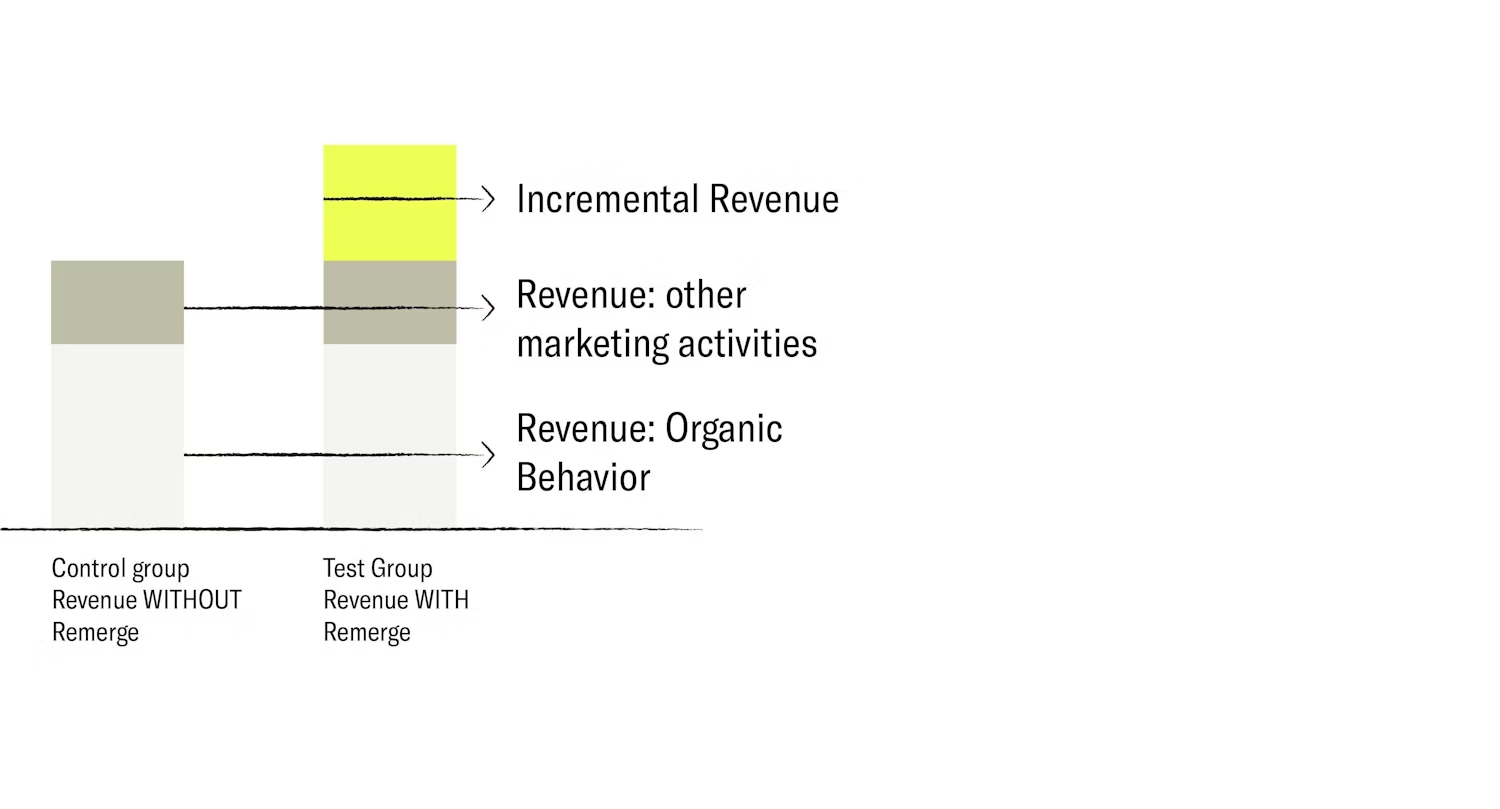
A report by Remerge showing the results of an uplift test. It presents the incremental revenue generated, on top of organic and other marketing-driven conversions. Also contains observed values such as ad spend, group sizes, amount of conversions, converters, and revenues per group, plus other metrics.

SKAdNetwork
skadnetwork

Stands for Store Kit Advertising Network. Apple’s measurement framework for tracking mobile attribution. Introduced in 2018 and widely implemented in 2020 with the iOS 14.5 update.

Segment
segment

A group of users with common attributes such as location, demographics, activity level, value or amount of purchases, and how recently they last opened a specific app.

Retention Rate
retention-rate

The share of users active in the app within certain time frames after install, reengagement, or other events.

Retargeting
retargeting

A type of marketing channel used by an app owner to engage with their existing users through other channels within the same device. Usually, the aim is to encourage users to complete a particular task e.g. completing a purchase, buying in-game currency, placing a first order. The conventional way of retargeting relies on user IDs, such as AAID and IDFA.

Reshuffle
reshuffle

Reshuffle indicates the randomization and marking of users when they were once part of a test or control group.

In incrementality measurement, reshuffling the group assignment for a specific application fights aggregated bias over time where one group doesn't see any ads while the other group is constantly exposed to them.

Reshuffling is relevant in cases where a test has been running for a long time and/or in campaigns the experience more extensive changes to the campaign setups, segmentation, or creative strategy.

Real-Time Bidding (RTB)
real-time-bidding-rtb

The process by which individual ad placements are bought and sold via programmatic auctions that happen instantaneously. With real-time bidding, ad buyers bid on an ad space, which, if the auction is won, instantly displays the buyer's ad. This lets demand-side players such as advertisers or DSPs optimize the purchase of ad placements from multiple sources.

Randomised Controlled Trial (RCT)
randomised-controlled-trial-rct

A method that randomly separates a specific population into two groups that are as similar to each other as possible, namely the test group and control group.

further reading
Queries Per Second (QPS)
queries-per-second-qps

The number of ad placements a DSP is able to process in order to determine on how to bid on them.

Publisher
publisher

Within the sphere of app marketing, a publisher is an App Developer that gets paid for placing ads within their app. For example, an advertiser wants to reach their users via App Y, so they pay App Y to display their ads.

further reading
Public Service Announcement Ad (PSA Ads)
public-service-announcement-ad-psa-ads

An incrementality testing methodology where devices in the control group are shown PSA ads, like donation drives or road safety reminders. By serving real ads, information on the devices within the control group that would have been exposed can be obtained. Unexposed devices are excluded from the measurement to reduce noise.

Probabilistic Attribution
probabilistic-attribution

Refer to: Attribution Methodology

Organic Behavior
organic-behavior

A user’s behavior not directly attributable to specific marketing efforts.

Multi-Touch Attribution
multi-touch-attribution

Refer to: Attribution Methodology

Mobile Measurement Partner (MMP)
mobile-measurement-partner-mmp

Within the sphere of app marketing, MMPs are a service provider that specializes in measuring activities that are happening within and leading to the app. An app publisher may incorporate an MMP into their app to track activity and events e.g. time spent on a certain screen, sources of incoming traffic, app opening frequencies etc.

Lifetime Value (LTV)
lifetime-value-ltv

The amount of revenue generated by the user for the App Developer during the entire duration of the relationship with the user, beginning with the app install.

Last-Click Attribution
last-click-attribution

Refer to: Attribution Methodology

Key Performance Indicator (KPI)
key-performance-indicator-kpi

The key metrics used to assess the effectiveness of an effort in achieving its objective. In programmatic advertising, the common types of performance indicators depend on the goals and nature of each campaign. These can include ROAS, cost per action, and retention rate.

Intent-to-Treat (ITT)
intent-to-treat-itt

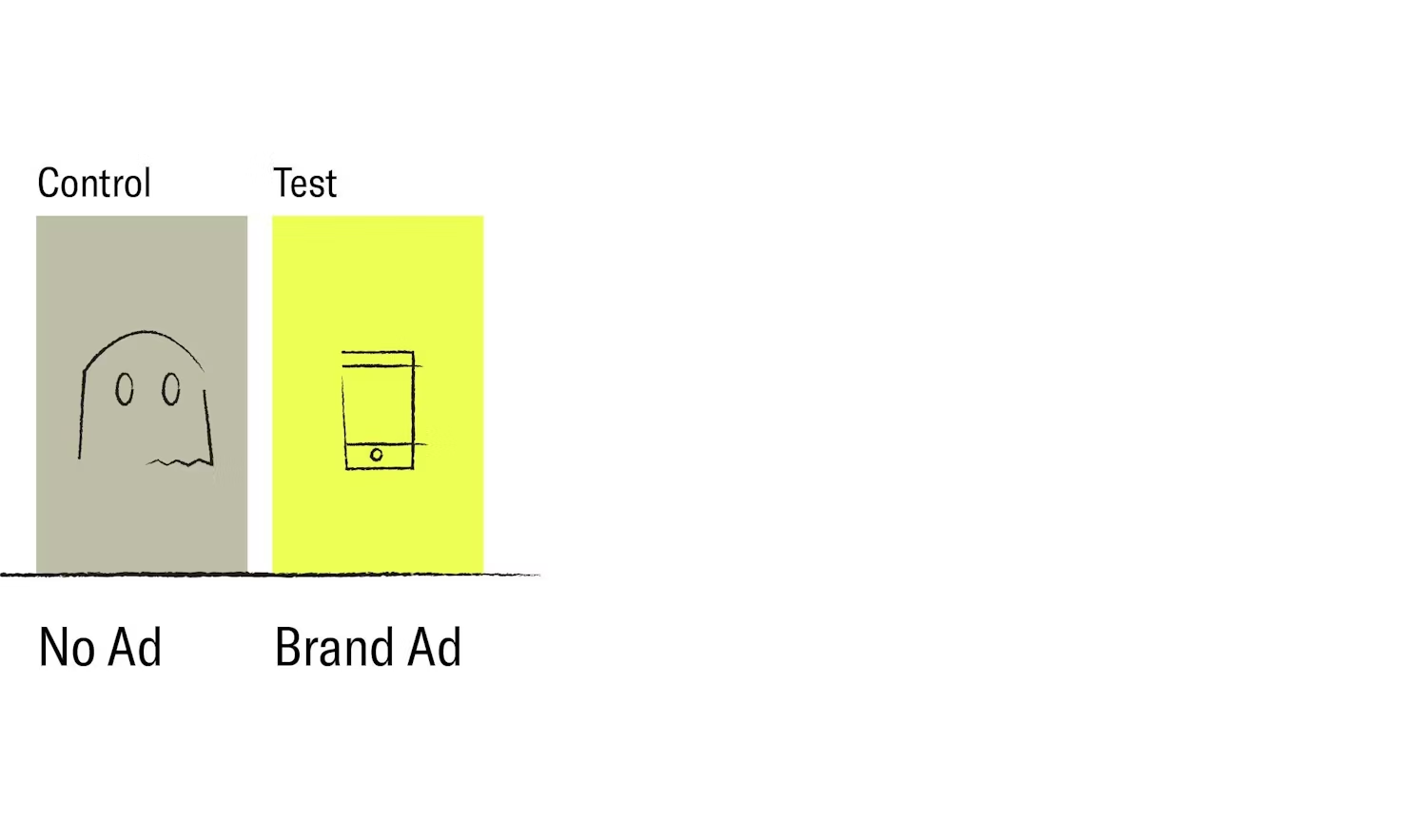
An incrementality testing methodology where no ads from the campaign are shown to devices within the control group. Also known as a ‘holdout test’. Cost-free and easy to implement, but with a relatively high level of noise.

This method compares the behavior of all users in both groups. In the test group, this includes both exposed and unexposed users

Incrementality
incrementality

A method of measuring the impact of a specific activity, on top of organic and other activity.

Incremental Revenue (iRevenue)
incremental-revenue-irevenue

The estimated revenue caused directly by the campaign.

Formula:Revenue from test group – revenue from control group = iRevenue

Incremental Return On Ad Spend (iROAS)
incremental-return-on-ad-spend-iroas

A KPI used in calculating how cost-efficient a campaign is. This is used to evaluate the relationship between incremental revenue and the amount of money spent on the campaign. The figure is typically represented in percentage.

Formula:
Percentage: [IRevenue ÷ ad spend] × 100 = IROAS%
Ratio: IRevenue ÷ ad spend = IROAS

Incremental Cost Per Action (iCPA)
incremental-cost-per-action-icpa

A KPI used to evaluate the cost of incremental conversions.

Formula:Ad spend ÷ [test group actions – control group actions] = iCPA

Incremental Conversions
incremental-conversions

The estimated amount of conversions caused directly by the campaign.

Formula:
Test group conversions – control group conversions (scaled) = Incremental conversions

In-app Event
in-app-event

Actions made by a user within the app, such as log-in, registration, completion of onboarding, or purchases. These events can be tracked with the help of an MMP.

Impression
impression

The deployment of the ad to the ad placement. An impression might not necessarily mean that the ad has been viewed.

Identifier for advertisers (IDFA)
identifier-for-advertisers-idfa

A unique random device identifier Apple generates and assigns to every iOS device. Advertisers can use this to track user activity across apps, show them personalized ads, and attribute ad interactions.

Ghost Ads
ghost-ads

A testing methodology that shows devices in the control group an ad ran by another advertiser on the platform, therefore removing any additional cost for clicks and impressions. The control group behavior is then marked with a ‘ghost impression’, which gives the information on which control group users would have been exposed.

further reading
General Data Protection Regulation (GDPR)
general-data-protection-regulation-gdpr

A regulation under the EU (European Union) law on data protection and privacy within the EU and the EEA (European Economic Area), that grants users control over how their data is stored and used by organizations. To comply with GDPR, programmatic sellers must clearly communicate to users how their data will be stored and used. When a user gives consent to an organization to process their data, it enables targeted advertising.

Exposure Rate
exposure-rate

The percentage of devices within a test group that received at least one ad impression, versus the total number of devices within the test group targeted within a campaign during an uplift test. For example, if 900 out of 1,000 users are shown an ad, the exposure rate is 90%.

See also: Uplift Test

Deterministic Attribution
deterministic-attribution

Refer to: Attribution Methodology

Deep link
deep-link

A link that sends users directly to a specific in-app location, instead of the app marketplace. Deep links bypass the steps needed to go through to reach a conversion point, bringing the user directly to where they can perform the intended action e.g. completing a purchase, buying coins, placing an order.

Test Group
test-group

Within the sphere of app marketing, this refers to the group of devices that may be shown ads from a specific campaign in the test. The actions on these devices are then compared to the actions on the devices in the control group.

Compare with: Control Group

further reading
Control Group
control-group

Within the sphere of app marketing, this refers to the group of devices within the target audience that are not shown ads from a specific campaign in the test. The actions on these devices are then compared to the actions on the devices in the test group.

Compare with: Test Group

further reading
Contextual targeting
contextual-targeting

A type of targeting that works with contextual signals only, such as location data (country, city, postal code), language setting, mobile operating system, device model, as well as publisher information.

California Consumer Privacy Act (CCPA)
california-consumer-privacy-act-ccpa

A bill that enhances privacy rights and consumer protection for residents of California, United States. The CCPA took effect on January 1, 2020.

The CCPA provides these rights to consumers:

- Know what personal data is being collected about them.
- Know whether their personal data is sold or disclosed, and to whom.
- Say no to the sale of personal data.
- Access their personal data.
- Request a business to delete any personal information that was collected from that consumer.
- Equal service and price, even if they exercise their privacy rights.

Attribution Window
attribution-window

A specific time frame that is taken into consideration when determining the source of a user’s action.

Attribution Provider (AP)
attribution-provider-ap

A role played by an MMP to credit the in-app activity of users to the correct media sources.

Attribution Methodology
attribution-methodology

Refers to the process of identifying which conversions belong to which preceding click or impression. Common attribution methodologies include:

  • Click-Through Attribution - Determines the source of a conversion based on the user’s click activity.

  • View-Through Attribution - Determines the source of a conversion based on the ad impression delivered to the user.

  • Deterministic Attribution - A model that establishes the origin of a user’s conversion from a specific click or impression, based on unique device IDs.

  • Probabilistic Attribution - A model that establishes the likelihood of a user’s conversion originating from a specific click or impression, based on the data logged on both occasions, such as device language, timezone, IP address, and OS version.

  • Last-Touch Attribution - A model that establishes a match between the action taken by a user (e.g. app open, purchase) and its corresponding ad click or impression. When a user converts from an ad, the DSP that delivered the respective ad is given full credit for that conversion event.

  • Multi-Touch Attribution - Also known as multi-channel attribution. A model determines the value of every touchpoint on the way to a conversion. Rather than giving full credit to one ad, multi-touch attribution divides the credit among all advertising channels that the user has interacted with, leading to the conversion.
Attribution
attribution

A method of identifying the touchpoints a user has encountered within a specified period before making a conversion.

App Tracking Transparency (ATT)
app-tracking-transparency-att

The privacy framework from Apple that, among other things, manages the process of obtaining user consent before accessing their Identifier for Advertiser (IDFA).

App Monetization
app-monetization

The strategy a publisher employs to earn money from their app. This can be done through in-app advertisements, paid membership, and charging for premium features or an ad-free experience, among others. For example, some gaming apps are free to download and play, but users may need to pay in order to progress to the next level quickly.

Android Advertising identifier (AAID)
android-advertising-identifier-aaid

Also known as Google Advertising Identifier. A unique device identifier that Android generates and assigns to every device. Advertisers can use this to track user activity across apps, show them personalized ads, and attribute ad interactions.

Advertisers
advertisers

The advertiser is a person or legal entity focusing on generating sales and leads through serving ads that convey the right message to the right audience at the right time.

In mobile advertising, the advertiser is on the client-side and is the one interested in promoting an app.

Causal Impact Analysis
causal-impact-analysis

A measurement framework developed by Google that works without device IDs. It measures the incremental uplift of one or more conversion events, removing the influence of other campaigns and organic conversions. Used to assess the effect of ID-less campaigns.

Similar to measuring the effect TV ads have, the principle is based on running campaigns on identifiable sub-markets (test group), while leaving other sub-markets unexposed (control group).

Ghost Bids
ghost-bids

An incrementality testing methodology based on Ghost Ads, adapted for retargeting campaigns. The difference is that it removes all devices that are not seen on ad exchanges, or that would not be bid on, from both test and control groups, to reduce noise. A bid is placed as usual for the test group, while the control group is tracked with ‘ghost bids’ (bids that could have been placed, but weren’t in the end).

Return on Advertising Spend (ROAS)
return-on-advertising-spend-roas

A KPI that measures the relationship between the revenue generated by specific advertising efforts and the money spent on them.

Formula

Percentage: [Revenue ÷ ad spend] × 100 = ROAS%

Ratio: Revenue ÷ ad spend = ROAS

See also: Incremental Return On Ad Spend

Supply-Side Platform (SSP)
supply-side-platform-ssp

A company that works with publishers to sell ad inventory across ad networks.

Demand-Side Platform (DSP)
demand-side-platform-dsp

A company that works with advertisers to purchase ad inventory across ad networks. Their platforms are built to identify a desired ad space and place bids on it.

Compare with: Supply-Side Platform

Open RTB
open-rtb

A digital marketplace where ad inventory from multiple publishers are available for advertisers to bid on in real time.

See also: Real-Time Bidding

Self-Attributing Network
self-attributing-network

An ad network like Meta, Snap, and Twitter, that attributes its traffic internally, without the involvement of third-party MMPs.

Variable Bidding
variable-bidding

The dynamic adjustment of bid prices based on a user's in-app behavioral patterns, contextual information, time of day, and ad placement performance.

Dynamic Product Ad (DPA)
dynamic-product-ad-dpa

Also known as a dynamic ad. It is dynamically assembled based on the user’s behavior and information sourced from a feed. This type of ad delivers a tailored experience for individual users.

Real-Time Audience Segmentation
real-time-audience-segmentation

The division of an audience into distinct segments based on real-time events, thus enabling targeted advertising and alignment with a user's behavioral patterns and preferences.

User Acquisition (UA)
user-acquisition-ua

A mobile marketing effort used to attract new users to an app. Paid UA may refer to ads shown in mobile ad networks or social media channels, while non-paid UA involves app store optimization and promotion on the advertiser’s own channels.

Programmatic Advertising
programmatic-advertising

The automated process of buying and selling advertising space through digital platforms.

Blog
Insights